
In January, the federal government released its newest poverty guidelines. For 2026, the Federal Poverty Level is $15,960 per year for an individual and $33,000 per year for a family of four, according to the U.S. Department of Health and Human Services.
A Formula Frozen in Time
What most people don’t realize is that the poverty line isn’t based on what life actually costs today. The measure traces back to the early 1960s, when economist Mollie Orshansky set the poverty threshold at three times the cost of a minimum food budget because at the time, food consumed roughly a third of a typical family’s spending.
Each year, the U.S. Department of Health and Human Services updates the guidelines by adjusting the Census Bureau’s poverty thresholds for price changes using the Consumer Price Index. However, the underlying measure itself still follows the 1963 threshold (three times the cost of a minimum food diet). Family budgets have changed quite a bit since 1963. Food is no longer the dominant expense; for most households, housing and child care are. As we’ve shown throughout this series, child care alone can cost an Indiana family more than food and housing combined. A poverty metric built on a sixty-year-old grocery budget structurally fails to account for the costs that break modern working families. The infographic below illustrates some of the ways that budgeting for modern life no longer meets the needs of the modern family.
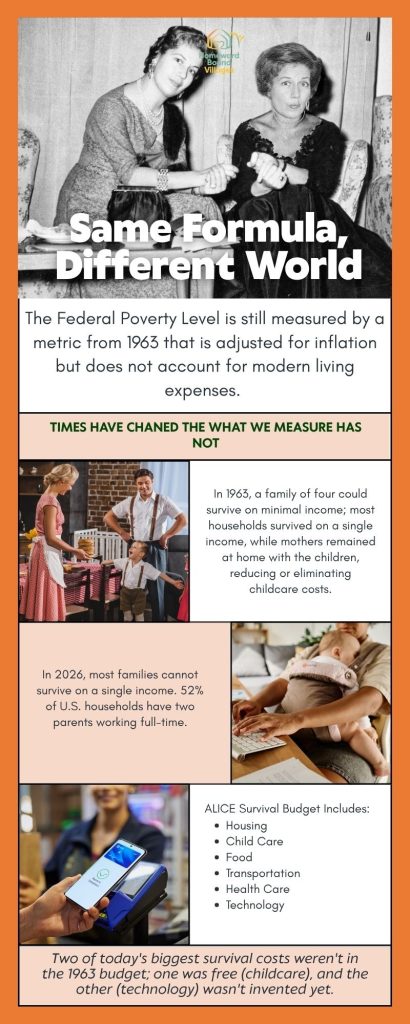
What does survival actually cost in America today?
The newly updated 2026 poverty line for a family of four is $33,000 according to the new HHS guidelines. The real cost for an Indiana family of four to cover just the basics- housing, child care, food, transportation, health care, and technology is $74,028 a year, according to the 2026 State of ALICE in Indiana report. The official measure of poverty leaves a massive gap in income and survival.
This gap isn’t imagined; it overwhelms real people. For example, two parents each working full-time at Indiana’s minimum wage earn $30,160 combined, which falls below the new $33,000 poverty line for their family of four. Meanwhile, a family earning $50,000 is nowhere near “poor” on paper but falls $24,000 short of survival in practice.
The Line is Not Imaginary; it’s a Barrier.
The Federal Poverty limit is the gatekeeper for federal and state assistance programs. Most set their eligibility as percentages of the poverty guidelines. When the line sits at less than half the cost of survival, families fall into a designed-in gap: earning too much to qualify for meaningful help, and far too little to be stable. In Indiana, this gap has a name: ALICE, which we discussed earlier in this series.
Measuring What Matters
None of this means the FPL should be ignored; it means it should never be the only definitive factor of what families need. That’s why this series has leaned on measures built from the ALICE Household Survival Budget and local housing data, rather than the poverty line alone.
The families living in the gap are working, parenting, and paying rent in La Porte County right now. They don’t show up in the poverty rate, but they show up in eviction filings, in school instability, and at the doors of local agencies. The poverty line may not see these families, but it is our goal to show this disconnect and recognize those who need help. Affordable housing is one of the ways we help these individuals build financial stability.
Other Blog Posts in this Series:
- One Emergency Away: How Quickly a Stable Household Can Lose Its Housing
- Rent vs. Reality in La Porte County: The Local Wage and Housing Gap
- The $74,028 Question: What a Family of Four Really Needs to Get by in Indiana
- Meet ALICE: The 38% of Hoosier Households Living One Emergency Away From Crisis
- The Jobs That Keep Our Community Running: Essential Work That Still Doesn’t Cover the Rent
Sources
- U.S. Department of Health and Human Services, Office of the Assistant Secretary for Planning and Evaluation — 2026 Poverty Guidelines (published January 2026)
- National Human Services Assembly, “Issue Feature: Calculating Poverty in the United States”
- United For ALICE, State of ALICE in Indiana (2026 release, 2024 data)