Housing is more than just a roof over one’s head; it’s the foundation for everything else in life, and directly impacts health, children’s education, the ability to keep a job, and the community’s economic strength.
La Porte County is currently paying a high price for housing instability. Everyone’s talking about housing development in our county, but affordable housing, the kind that actually promotes economic growth, keeps getting pushed aside. Here’s what we want to communicate: this county is already spending the money. It is just spending on emergency room visits, lost productivity, and crisis interventions, rather than investing in solutions that prevent the problem from happening in the first place. Affordable housing in the county is key to sensible economic development. In today’s blog post, we are going to show how the county is already paying to address the needs created by a lack of affordable housing, further making the case that affordable housing solutions aren’t a nice-to-have; they’re a need-to-have in our communities.
The Hidden Costs We’re Already Paying
Healthcare Costs That Could Be Prevented
When families are housing insecure, health becomes a secondary concern. According to the U.S. Department of Health and Human Services, cost-burdened households, those spending more than 30% of their income on housing, have little left over for necessities like food, clothing, and healthcare.
The health consequences are real and expensive. According to Housing Matters, Urban Institute research project, households with poor housing quality had 50% higher odds of an asthma-related emergency department visit in the past year. People experiencing housing instability are more likely to rely on emergency rooms for medical care rather than having a usual source of care, driving up costs for everyone.
Dr. Megan Sandel, an associate professor of pediatrics at Boston University School of Medicine, wrote an article on the Impact of Housing Affordability on the Economy for Habitat for Humanity. “We as a country always act like we can’t find the money to solve this home affordability crisis, which implies that we are not spending it now. We are spending it now. We are just spending it on adverse health and bad outcomes.”
The Workforce Crisis Businesses Are Facing
In La Porte County, 48% of renters are cost-burdened, spending more than 30% of their income on housing. This is even higher than the national average, where 48.2% of renters are housing cost-burdened according to the U.S. Census Bureau.
This matters to every business in our county. A 2004 report by Habitat for Humanity showed a harmful link between high housing costs and employee recruitment, productivity, and retention, which hurts businesses and the local economy.
Workers who lose their homes are 11 to 22 percentage points more likely to lose their jobs, according to an article by Camoin Associates titled “The Impact of Affordable Housing on Economic Development.” When our workforce can’t afford to live near their jobs, businesses struggle to hire and retain the talent they need to grow.
According to the Indiana Business Research Center, two-thirds of Indiana’s largest occupations, including nursing assistants, industrial truck operators, home health aides, and childcare workers, pay median wages below what’s needed to afford housing, as reported by the Out of Reach Report published by Housing4Hoosiers late last year. This isn’t sustainable for families or for economic development.
Education Outcomes Our Children Deserve
Housing instability doesn’t just affect adults; students experiencing homelessness are 87% more likely to drop out of school than their housed peers, as cited by the National Center for Homeless Education. Living in poor-quality housing and disadvantaged neighborhoods is linked to lower kindergarten readiness scores. Housing instability has a lifelong effect on children experiencing it.
When children are worried about where they’ll sleep or if their family will have to move again, learning takes a back seat.
The Cycle That Keeps Families Trapped
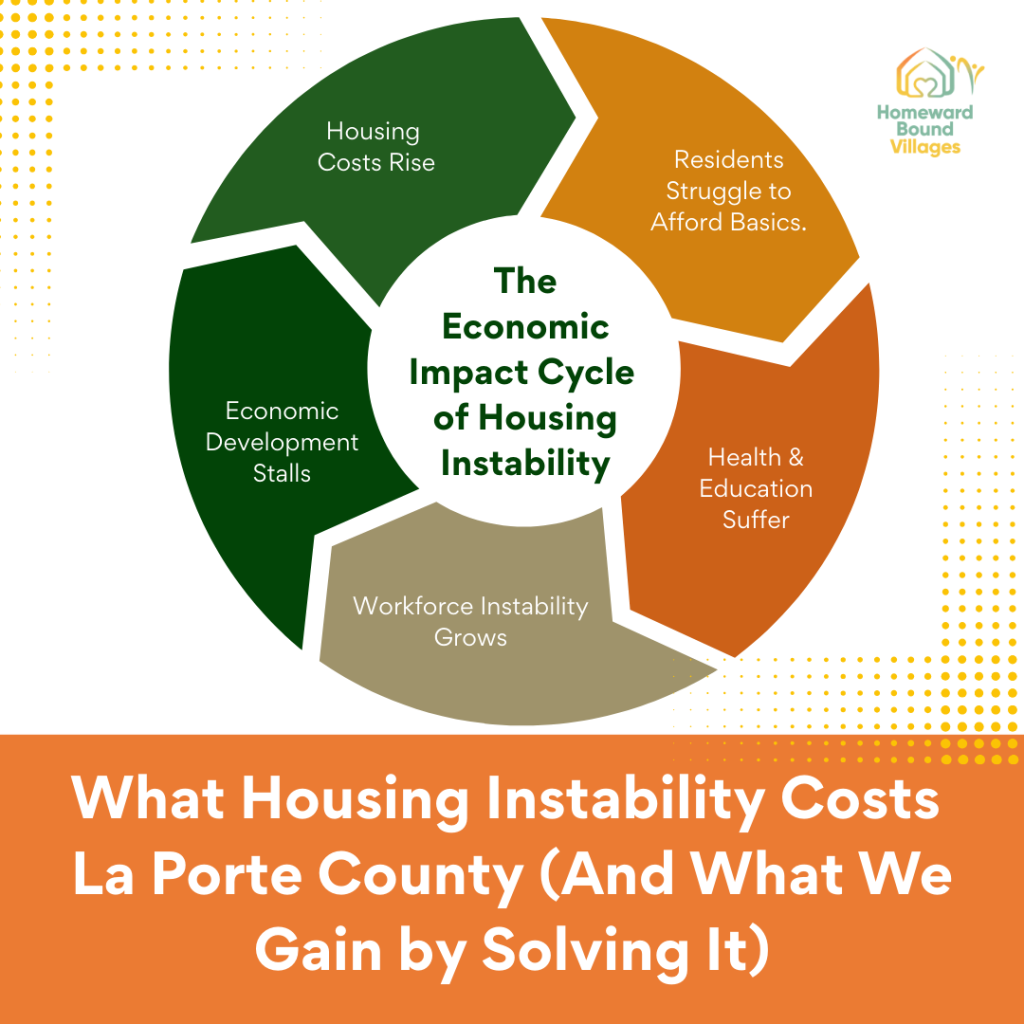
We know that unstable housing disrupts employment, social networks, education, and access to social services, creating a vicious cycle: job loss leads to more instability, which worsens health problems that make it even harder to work.
According to an article on the website Health Affairs, “severely cost-burdened renters are 23% more likely than those with less severe burdens to face difficulty purchasing food.” This means families are forced to choose between paying rent and buying groceries or between keeping the lights on and filling prescriptions.
What La Porte County Actually Needs
According to a comprehensive housing study conducted by SB Friedman Development Advisors for the City of La Porte, our county needs over 900 for-sale housing units and 750+ rental housing units to meet demand in the coming years. The Health Foundation of La Porte specifically identifies the need for at least 240 “affordable units” and 660 “workforce units” in the City of La Porte alone.
The shortage impacts residents across all income levels but especially affects low- and moderate-income households. Indiana’s Housing Wage, the hourly wage needed to afford a two-bedroom rental, was $22.18 in 2025, but the average renter’s wage is well below that. As a reminder, Indiana’s minimum wage is $7.25 per hour. According to the ZipRecruiter website, the average hourly rate in Indiana is around $20.22, which is still two dollars below the living wage.
What We Gain by Solving It
Healthier Community, Lower Costs
We know, and multiple studies support, that improving access to high-quality, affordable housing is associated with higher life expectancy and lower rates of chronic disease and hospitalizations.
State Medicaid programs in Oregon, Massachusetts, New York, and Vermont have sought waivers to spend Medicaid funds on providing permanent shelter for patients experiencing homelessness, because it’s ultimately much cheaper than paying for the emergency care that homeless and unstably housed patients often seek, according to the website Health Affairs.
When families have stable housing, they often have better access to healthcare and experience fewer hospital visits, reducing overall medical costs.
Stronger Local Economy
When housing costs are more affordable, families increase their discretionary income significantly. That’s money that stays in our local economy, spent at restaurants, grocery stores, and small businesses. New housing development also creates jobs, as new residents generate greater demand for local businesses and services.
The availability of stable, high-quality, and affordable housing generates long-term economic benefits for residents and helps communities attract and retain a strong job force.
Better Educational Outcomes
The HUD Family Options Study showed that access to affordable housing brings significant benefits to the community, including less food insecurity, fewer school moves, and better well-being for adults and children. The study also provides evidence that offering access to affordable housing enhances family well-being and greatly reduces child separations and domestic violence.
When children have stable housing, they attend school more regularly, perform better academically, and have better prospects for future educational attainment and employment. Housing stability creates a solid future for children to build upon.
Thriving Workforce
Available, affordable housing is a vital part of workforce and economic growth. Without it, workers may move to other cities for better options, become cost-burdened, or experience homelessness or housing insecurity, according to the Indiana Business Research Center.
Affordable housing draws a more diverse talent pool, including younger workers and those with skills for essential jobs. It helps our existing businesses expand and makes La Porte County more competitive in attracting new employers.
Affordable Housing is Economic Development
Housing affordability isn’t just a social issue; it’s an economic development strategy. As Dr. Sandel noted, “we’re already paying the costs of housing instability through healthcare spending, lost productivity, and emergency interventions.”
When we invest in affordable housing, we support healthier families, better-educated children, stronger businesses, and a more prosperous La Porte County. The data shows: stable, affordable housing isn’t just good for families; it’s the foundation for economic growth that lifts our entire community.