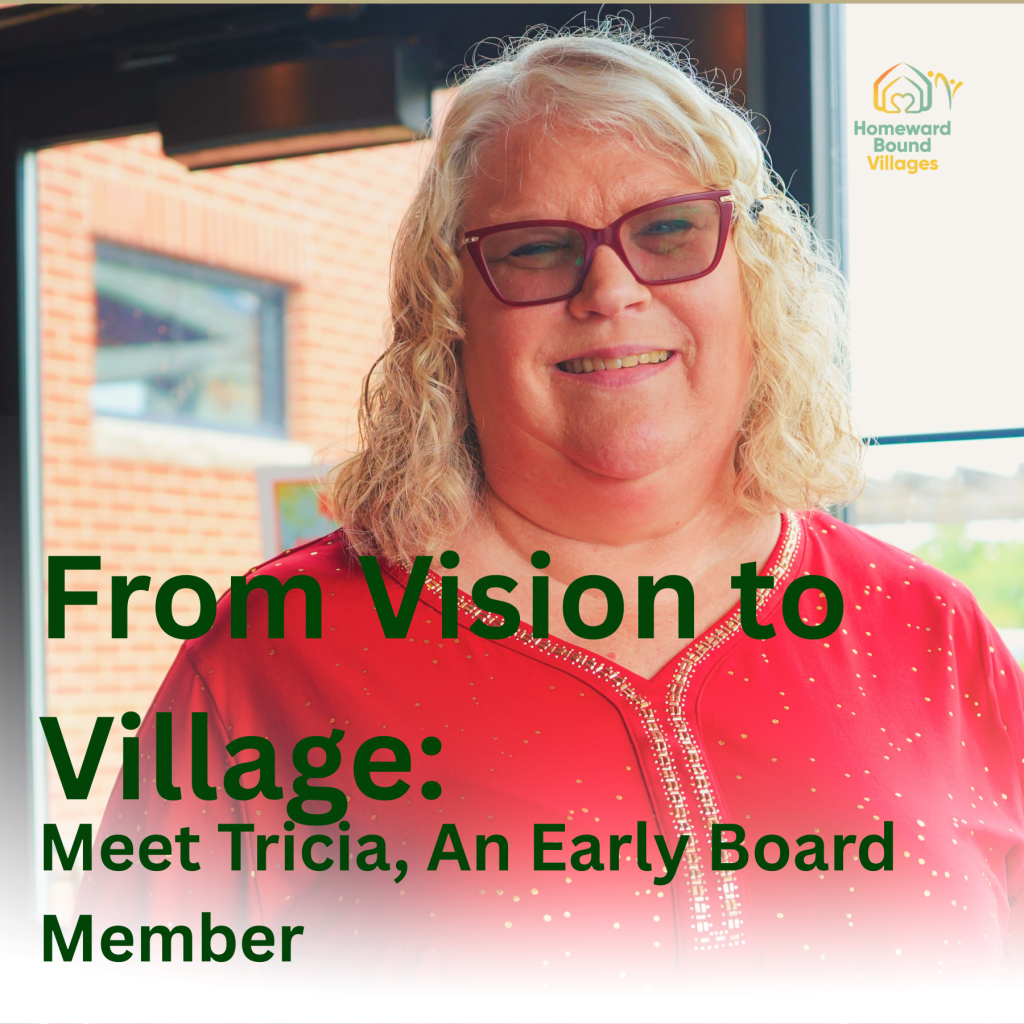
After more than a decade of service, Tricia Kuiken stepped down from the Homeward Bound Villages board this past January. Her involvement began long before there was a formal seat to fill, and it traced the organization’s entire journey, from the decorated shopping-cart fundraiser on Franklin Street to families turning the key in their own front doors at Karwick Village. We sat down with Tricia to talk about how she got involved, how the vision evolved, and what she hopes comes next.
You started with Homeward Bound almost by accident. Can you take us back to the beginning?
“Homeward Bound was co-founded by my dad (John Vander Wagen) and Leigh. For those first years, all they talked about was Homeward Bound. You could not have a conversation with either of them without it redirecting back to it. We would all meet for dinner, and it was nonstop Homeward Bound. To the point where I’d say, “Okay, guys, enough, let’s talk about something else tonight.
But the early days were really about the shopping cart fundraiser. That’s how I started getting involved. Different nonprofits around the city would each get a shopping cart, decorate it, and raise their own donations. They’d bring everything to St. Paul Church, and my father would count all the money. One year, he asked me to come help him count, and I said, “Okay, Daddy, I’ll come do that.” We’d crown a winner and parade the carts down Franklin Street, and the winner got a little trophy with a shopping cart on it.”
What pulled you into Homeward Bound Villages?
“My dad said one day, “We have an advisory board meeting today, and I could use somebody to take notes.” I said, “This is a one-and-done, right?” He said okay. Then they called me again. “Can you come take notes?” “Sure, Dad.” Little by little, I just kept getting my toes deeper and deeper in. Eventually, we started meeting every month, and I thought, “Okay, let’s do this.”
Why did you stick with it for so long?
“My dad worked a lot when I was a kid. He’d leave at 5 a.m. and get home at 1 a.m. He spent about six months in Hong Kong one year, running the company’s distribution center after the man who was supposed to be there got sick. I didn’t get to spend much time with him growing up, so this was a chance to see a different side of him, to get to know him beyond the parent role. That’s really why I did it, and why I stayed.”
You served on the board right up through the opening of Karwick Village. What was it like to welcome residents home?
“I bawled like a baby. I was so excited to see people moving in. I’d drive by and say, “Oh, look, honey, they’re putting up a community center.” That’s the goal right now, fundraising for the community center, as the co-op gets up and running. They have a great consultant helping the villagers and community partners figure out what that looks like.”
Last year’s building of Karwick Village moved quickly. How did that happen?
“Sandi Keller, Homeward Bound Village’s President, did 99.9 percent of it. We wouldn’t be where we are today if it weren’t for her. She’s a force of nature. When she first started coming, she just attended the meetings and listened for a year, maybe longer. I always thought it was a little curious that this person we didn’t know was just sitting in. But I think she wanted to make sure we were a reputable, decent organization before jumping in. Her Habitat for Humanity background was such a blessing, because we’d been struggling to get everyone on the same page about what Homeward Bound even was.”
Tell us about that struggle. The vision changed a lot, didn’t it?
“The original idea, what Leigh loved, was modeled on what he saw in Austin, Texas. Tiny homes or even tents on large pieces of land, with a community center that served as the kitchen, the showers, and the locker rooms. The houses themselves wouldn’t have had any of that. I kept saying, “This is Northwest Indiana, we can’t have people living in tents in the winter.” And I felt strongly that there needed to be a bathroom in every house. Nobody wants to walk out to a communal bathroom at three in the morning in January. A little kitchenette with a microwave is fine; it doesn’t need to be fully built out, but a bathroom, yes.
That plan also included on-site mentors who would live in the community and help residents, master gardeners, and leather workers teach skills people could sell at the farmers market or craft fairs, and help with budgeting. What we built is completely different. The cooperative piece is still there, just in a different form, and I’m happy about that. I like that it’s a small community of small homes.”
Another big shift was the language itself.
“Getting the word ‘homeless’ out of our vocabulary was very, very difficult. I wrote a three-page letter to the board about it. Whenever you’d tell someone, “We’re going to build a community for the homeless,” the response was, “Oh, no, you’re not.” I kept saying, ” This isn’t just for one group of people. You don’t know how many elderly people living on a small Social Security check come through my door at the church and say they can’t put food on the table, pay rent, and afford their medications. It needs to be for anyone living below the poverty line, or near it, who needs help. It took a while to get everyone on board, but it mattered.”
You see that need firsthand in your work at the church.
“I do. We work with a lot of people who pay $50 a day to stay in a motel just to keep a roof over their heads. My clients are often older adult ladies who have just lost their husbands and are now on a fixed income that won’t keep them in their homes. That’s the reality for so many people.”
The community model changed in another important way, too: the length of time people can stay.
“Originally, the plan was to give people a year or a year and a half, get them stable, and move them back into traditional rentals. Then one day, we said, ” No, we’re going to let people stay as long as they want. When you let people put down roots, they’re healthier, and the community is healthier. It’s a win all the way around.”
Before we close, what do you most want people to know?
“This is a really great organization, and we could use a lot more financial support from our communities. I want the town leaders across La Porte County to really step up, because both La Porte and Michigan City need this. These communities need help, and we need the local business leaders and town leaders behind us. We did this without taking a dime from the federal government because we didn’t want to be bogged down in red tape.
We have six homes up and six families housed, and another six coming. We have to start somewhere. But Homeward Bound Villages can’t do it all without significant community support. My hope is that the leaders of our towns look at what’s been built, see how well it’s running, and say, “We need to help this organization build more.”