In La Porte County and across most of the United States, affordable housing is a growing concern and becoming an ever more urgent issue to solve. We believe that affordable housing requires innovative solutions, from changes in zoning to cooperative-style housing like that at Karwick Village to seeking out other housing solutions. The goal is to bring affordable housing to our community and keep residents here in La Porte County, in the communities where support networks thrive, and community connections are lifelines.
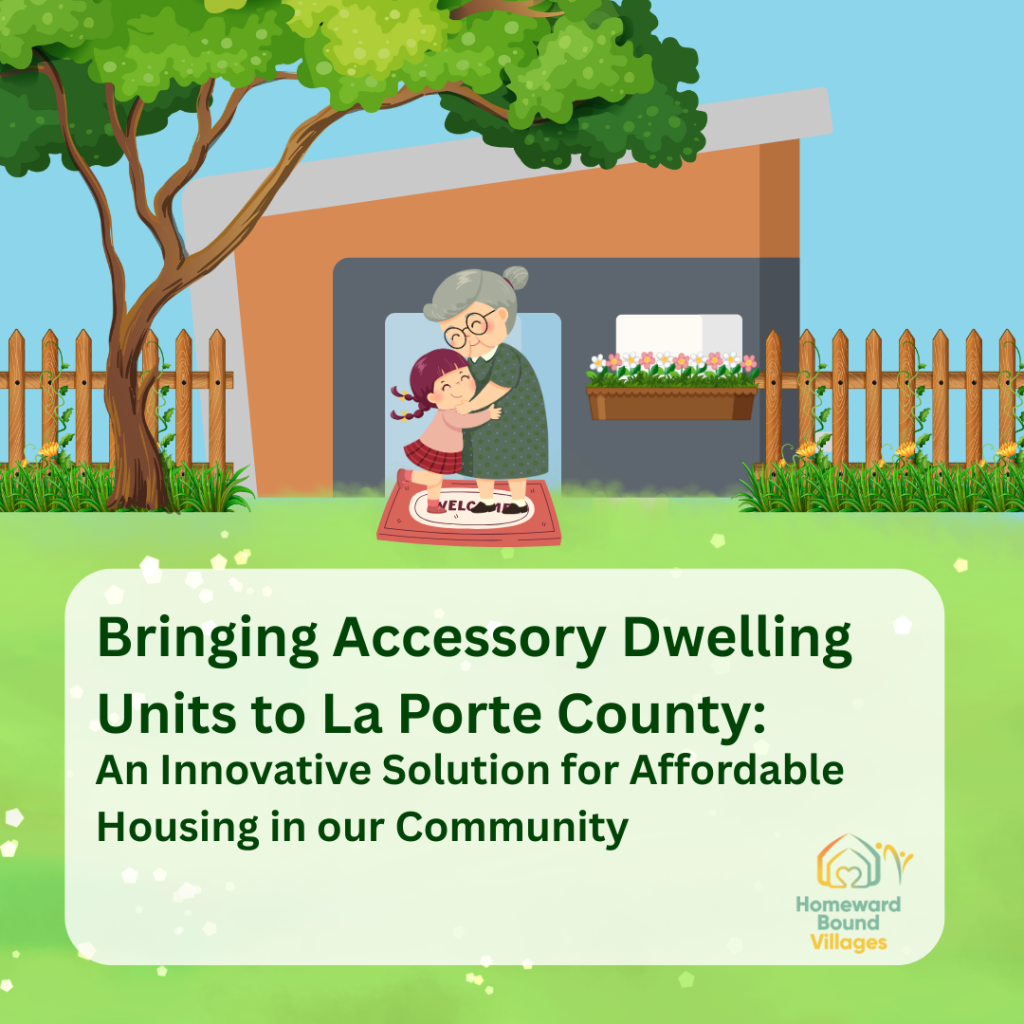
Today, we would like to discuss an innovative solution that is gaining traction nationwide: the Accessory Dwelling Unit (ADU). This flexible housing option has the potential to transform how we address these challenges locally. With changes to our zoning code that allow these affordable, low-impact housing solutions, we can bring more affordable housing to La Porte County.
What Are ADUs?
Accessory Dwelling Units are independent housing units located on the same lot as a single-family home. Often called granny flats, in-law suites, backyard homes, or carriage houses, these versatile structures typically range from 400 to 1,200 square feet and can be attached to the primary residence, converted from existing spaces like basements or garages, or built as separate structures on the property.
The website AccessoryDwellingUnits.org, they define ADU’s simply stating that “An accessory dwelling unit is a really simple and old idea: having a second small dwelling right on the same grounds (or attached to) your regular single-family house, such as: a basement apartment, an apartment over the garage or a tiny house (on a foundation) in the backyard”
Benefits ADUs Could Bring to La Porte County:
Innovative Affordable Housing Options
ADUs represent a unique opportunity to increase our housing supply without requiring new land development. By creating additional living spaces on existing residential lots, we can provide lower-cost housing options throughout our community. These residential lots already provide most, if not all, of the infrastructure needed to support a habitable dwelling, such as sewer, water, and electricity.
Construction costs for Accessory Dwelling Units (ADUs) are considerably lower than building new single-family homes, as they don’t require land acquisition and are typically smaller in size. This cost efficiency often translates to below-market rental rates, thus providing an affordable housing solution in our community, according to a Habitat for Humanity Evidence Brief completed in partnership with the AARP on Affordable accessory dwelling units. Studies show that nearly 60% of ADU homeowners rent their units at below-market rates. The study goes on to say that only about 12% of homeowners use ADUs as short-term rentals, meaning the vast majority become permanent housing options for our community members.
Supporting Housing Stability
ADUs offer remarkable flexibility throughout their lifecycle, adapting to changing family and community needs over time. They can generate valuable rental income for homeowners living on fixed or limited incomes, providing financial stability against unexpected costs, such as medical expenses or job loss.
This supplementary income can be particularly beneficial for homeowners struggling to cover mortgage payments, housing expenses, and property taxes, thereby helping to prevent displacement and maintain neighborhood stability.
Enabling Aging in Place
As older adults in our community age, they often seek suitable housing solutions that allow them to maintain independence. ADUs offer an elegant solution that benefits both older adults and their families.
The smaller footprint of these units often means that they are built to be easy to maintain. In many cases, units can be designed with accessibility features and universal design principles that promote safety and mobility. This also benefits anyone in the community with a mobility issue.
These dwellings offer older adults the option to downsize into a more manageable space while remaining on their property or close to caregivers who can provide support. This also keeps older adults in the community and neighborhood that they may have lived in for decades, thus retaining their local support network.
The financial benefits can also be substantial. With older adult residential care costing over $100,000 annually and assisted living facilities exceeding $50,000 per year, ADUs represent a significantly more affordable alternative that keeps seniors connected to their communities and support networks.
The Evidence Brief mentioned earlier found that among adults 50 or older, 69% would consider living in an ADU to be close to family while maintaining their own space, and 68% would build an ADU to house a caregiver.
ADU’s Are Not Just for Older Adults:
Many of these benefits that older adults would experience from an affordable housing solution provided by ADU’s would also translate to other individuals within the community.
The smaller footprint of an ADU means that, in most cases, the energy costs would be much more affordable. Due to the size of most ADUs, these dwellings are ideally built for one or 2-person households, thus keeping any maintenance costs at a minimum.
Another benefit to the larger community is that neighborhoods have the opportunity to welcome new residents, as well as keep established residents within the community. This builds a neighborhood that is multigenerational, thus building stability within the neighborhood.
ADUs provide great affordable housing solutions for college students and young adults who are just starting out. They also provide great accommodations for individuals living alone or who want a smaller footprint in a living space.
Learning from Successful ADU Programs
Looking at communities that have already implemented ADU programs provides valuable insights for how we might approach this in our own community:
Habitat for Humanity Metro Denver
In Denver, Colorado, Habitat for Humanity partnered with the West Denver Renaissance Collaborative (WDRC) to create the West Denver Single Family Plus (WDSF+) ADU Pilot Program. This initiative helps homeowners in neighborhoods experiencing gentrification plan, design, finance, and build Accessory Dwelling Units (ADUs).
The program completed six Accessory Dwelling Units (ADUs) and has ten more under construction, with costs ranging from $184,000 to $240,000, which is significantly less than the $465,000 average for newly constructed homes in the area. Most importantly, 83% of homeowners in this program are households of color seeking to house family members, demonstrating how ADUs can promote housing equity.
The Denver program shows the power of partnership. Habitat focused on design and construction while WDRC handled homeowner selection, technical assistance, and financing.
Habitat for Humanity Monterey Bay
In California, Habitat Monterey Bay developed two ADU programs, including “My House, My Home,” which specifically targeted seniors aged 62 and older. This initiative helped older homeowners build or renovate Accessory Dwelling Units (ADUs) on their properties, allowing them to either downsize into a fully accessible ADU or remain in their main house and generate income by renting out the ADU.
Over the past 12 years, they’ve built eight Accessory Dwelling Units (ADUs), with seven being detached, new-construction units. Three of these are specifically part of the ‘My House, My Home’ program. The program includes affordability requirements to ensure these units serve low-income residents.
One Monterey Bay homeowner, who has lived in their house for 65 years, shared, “Building an ADU through My House My Home makes me feel really good… it makes me feel like I fit in with the community.”
Habitat for Humanity Metro Maryland
In Maryland, Habitat developed an Accessory Dwelling Unit (ADU) program that focused on community education and advocacy to improve the acceptance and understanding of ADUs.
Bringing ADUs to La Porte County:
For our community to successfully implement an ADU program, these key factors have proven effective elsewhere and should be considered here:
- Simplify regulations: Relaxing or removing restrictive zoning requirements would encourage ADU construction. Communities that have streamlined their permitting processes have seen significant increases in ADU development.
- Reduce financial barriers: Providing economic incentives and developing innovative financing options could help make ADU construction more affordable for homeowners.
- Provide education and resources: Creating toolkits, offering pre-approved designs, and providing technical assistance would make the process more accessible to homeowners, particularly those with limited resources.
Bringing Innovative Solutions to La Porte County:
ADUs represent a promising solution to many of our community’s housing challenges. Our housing challenges are similar to those of many communities across the United States. As we did research for this article, we came across dozens of case studies on how the adoption of ADUs can bring about a quick, more cost-effective, and broad solution to affordable housing in our community. By learning from successful models nationwide, we can develop an approach that addresses local needs while promoting housing affordability, neighborhood stability, and housing equality.
The evidence is clear: ADUs create additional housing options, help homeowners build financial security, support aging in place, and enhance community resilience. The question is not whether Accessory Dwelling Units (ADUs) could benefit La Porte County, but how quickly we can implement a program that brings these benefits to our residents.
As a community, let’s work together to bring this innovative housing solution to La Porte County and create more opportunities for all our neighbors to find affordable, stable homes that meet their needs.
Click here to learn more about the Affordable Accessory Dwelling Units: Innovative Housing Solutions for Households with Low Incomes and Older Adults, or read the Evidence Brief: https://www.habitat.org/sites/default/files/documents/ADU-Evidence-Brief_Habitat-AARP.pdf
There are numerous case studies highlighting the benefits of incorporating ADUs into a community. We also recommend this website (AccessoryDwellingUnits.org) is an excellent resource if you are interested in learning more about ADUs in our community.