What does it mean to build a community? Is it the person who physically builds the community, the one who designs it, or those who bring the vision? At Homeward Bound Villages, we believe it is all of these individuals, and so many more, who turn an unused piece of land into a community that is forever affordable and set up for long-term stability. Today, we reflect on what our community builders had to say about Homeward Bound Villages and the building of Karwick Village.
The Why: Where Builders Begin
Every builder starts somewhere. For the two men who founded Homeward Bound Villages, the beginning was not a blueprint or a budget. It was a moment of seeing something they had not let themselves see before.
For Leigh Coburn, it came over a cup of coffee. A friend from church who worked the overnight men’s shelter asked Leigh what he thought of the unhoused. Leigh answered honestly: he was uneasy around them. If he saw an unhoused person walking toward him on the sidewalk, he would cross the street to keep his distance. His friend thanked him for his honesty, then asked him to sit down for coffee with a few of the men who made him uncomfortable. Two of them were college-educated, well-spoken, and had simply fallen on hard times after losing steady work. That conversation set Leigh on a nationwide search for the best ways to help people rebuild their lives.
For John Vander Wagen, the lesson came decades earlier, behind his family’s coal yard. As a boy, John noticed a hole in the fence that let coal slip out into the alley, and he told his father it needed fixing. His father told him to leave it. The gap was there on purpose because some people had no way to pay for coal and had to take a little at a time to stay warm through the winter. It was, as John put it, his first experience doing something for others. He grew up in a family that delivered coal, ran soup kitchens, and gave away coats to take care of others.
What brought them together was a shared frustration with how easily progress could come undone. The founders had spent years building a support network: feeding people through churches, helping them find jobs, teaching financial skills, and getting them into rental housing. They were home. Then rent would climb, or a job would disappear, and the people they had worked so hard to help were back on the street.
“There needed to be a better solution.”
That solution became the cooperative village model, and the principle the founders insist on is permanence. Leigh was wary of a rent-to-own approach because rising real estate values could price out the very families Homeward Bound Village exists to serve. The goal, instead, is housing that stays affordable not for a season but for good.
For John, the model’s deeper promise is relational, not just financial. In a cooperative, every resident shares in the governance, operation, and care of the community. Homeward Bound Village provides the early mentoring and training, then steps back as neighbors build something together. The result, he believes, is a place where people form lasting relationships rooted in trust, mutual respect, and genuine concern for one another. As he puts it, an organization cannot talk about community and fail to be a good neighbor.
Neither founder sees the work as finished, and neither sees it as theirs to hold onto. Leigh’s hope is that the model proves so successful that other communities replicate it and claim it as their own. John, with characteristic humility, says his role now is to make room. His days, he says, have set the stage. What comes next belongs to the people who build on it.
The How, Our Community Partners
It is often said that it takes a village to build a home. At Karwick Village, that has been literally true. Long before the first residents moved in, a group of local professionals chose to contribute their expertise to the project, many donating work they would normally be paid for. Their reasons varied, but the common thread was the same: they saw a community taking shape and a place for themselves in building it.
For Shem Khalil of Global Engineering, the commitment has spanned a decade. The partnership began with a simple conversation between friends, when co-founder Leigh Coburn described the toll the housing shortage was taking on the community. For Shem, a civil engineer who knew the area well, that conversation reframed a familiar problem as a chance to act. He has since donated countless hours to HBV, from technical engineering guidance to Community Center architecture plans. What stays with him is not the engineering. It is the purpose behind it.
“It wasn’t just about buildings; it was about creating a community for all.”
Where Shem prepared the ground, Roger Potratz drew what would stand on it. The architect behind Karwick Village’s triplex homes, Roger, has been part of HBV since its inception, providing countless hours of consulting, site layout, and design work. He came to the project with a lifelong commitment to energy-conscious building, and he brought that same care to Karwick Village’s efficient, thoughtfully sized homes. But ask Roger about the heart of the design, and he does not start with insulation. He starts with the porches and the way the homes face one another. You do not want to see your neighbor’s back when they walk out the door, he explains. In a village, you want to see their face. After more than fifty years in the profession, what still moves him is not the drawing but the living that happens inside it.
“You create spaces where people live their whole lives and make memories.”
Molly Hannon gave those spaces their warmth. As the exterior designer for Karwick Village, Molly set out to challenge a quiet assumption that affordable housing has to look the part. Trained in classical architecture and new urbanism at Notre Dame, she pushed for design that is clean and fresh but also warm, with front porches on every unit, native landscaping, a color palette built to outlast trends, and personalized front-door colors so each resident can claim their own home within a cohesive whole. Her point is not decoration for its own sake. Done well, she explains, design quietly shapes how a place feels to live in, and a home someone is proud of affirms their worth.
“Everyone deserves to live in really beautiful spaces.”
These three are only part of the story. The list of people who gave to Karwick Village, in skill, in labor, in dollars, and in patience, runs far longer than any one post can hold. Builders, tradespeople, funders, and neighbors all left something of themselves in the place. What they share is a belief Shem put most simply: this was never about any one organization. It was about building community.
What It Means to Be a Builder
Ask any of these individuals what they built, and the answer is rarely “a house.” Leigh and John built a reason. Shem built the ground. Roger drew the rooms. Molly gave them warmth. Jimmy Pressel, our Phase 1 Project Manager for Karwick Village, brought it all together in perfect coordination. When pressed, each of them returned to the same word the founders started with: community.
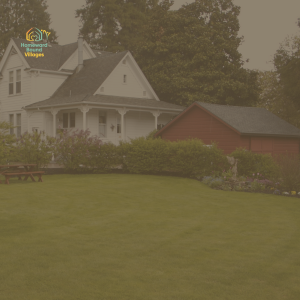
It is there on the porches, maybe most of all. Roger led the design, in coordination with Hitchcock Design Group, to face the homes inward so that neighbors would see each other’s faces, not each other’s backs. Molly put a porch on every unit so there would always be a place to sit, wave, and linger. They arrived at the same idea from different directions, the architect and the designer both reaching for the same small, human thing: a place where affordable housing creates intentional community.
That is what it means to be a builder at Homeward Bound Villages. Our work is about making a community where people can put down roots and stay, and inviting your neighbors to help you do it. The founders asked the question. The partners answered it. And the village they made together is still asking the rest of us the same thing.
There is room on this porch for you. Whether you give your time, your talent, or your treasure, there is a place for you in building what comes next. To learn how you can be part of it, reach out at info@homewardboundvillages.org.