
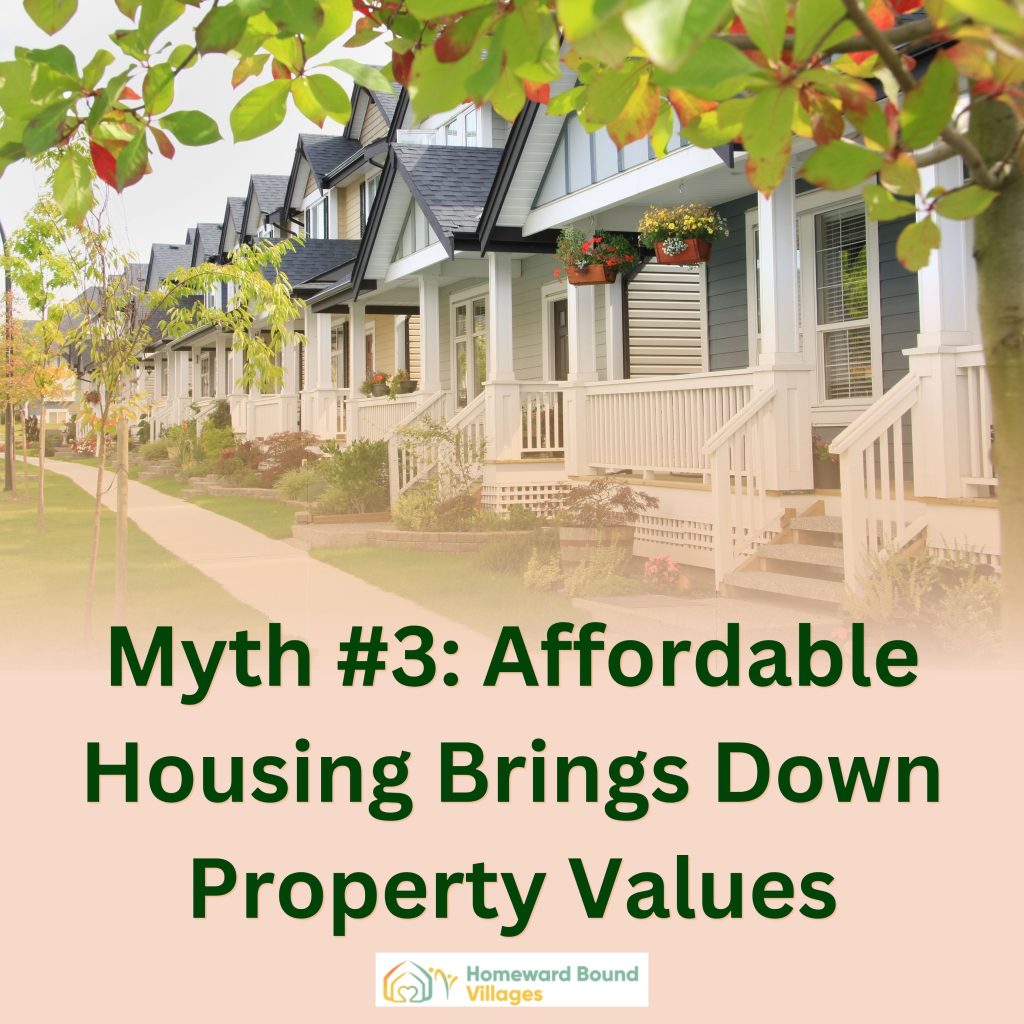
April is Myth-Busting Month at Homeward Bound Villages, and we are moving on to Myth#3: Affordable Housing Brings Down Property Values. All month long, we are challenging the assumptions that block progress on one of La Porte County’s most urgent needs. You can read the other posts in the series here
· Myth #1:Affordable Housing Means Low-Quality Housing
· Myth #2: Myth #2: Affordable Housing Is the Same as Public Housing
The argument that appears at almost every community meeting where affordable housing is discussed is that it will hurt property values. Neighbors often share the same concern: what will this do to the value of my home? It is an understandable question, given that for most families, a home is the biggest financial asset they will own. The fear of losing that value is real and deserves serious consideration. So, let’s look at what the evidence shows.
What the Research Says
The body of research on this question is substantial and consistent, and it largely points in one direction. According to the National Association of Realtors, research on the effect of low-income housing on neighborhood property values has mostly shown little to no impact or a positive impact. According to 13 studies reviewed by the A-Mark Foundation, 7 found that when affordable housing was built, property values in surrounding neighborhoods increased.
One of the most thorough recent studies comes from the Urban Institute, which analyzed home price data in Alexandria, Virginia, from 2000 to 2020. Researchers found that affordable housing developments were associated with a small but significant increase in property values within one city block of each development. This effect was seen in both lower- and higher-income neighborhoods.
A 2022 study published in the Journal of Housing Economics examined over 500 affordable housing developments built in the Chicago area from 1997 to 2016 and analyzed their impact on more than 600,000 nearby residential property sales. The researchers found that these developments had positive effects on local property prices and that increasing development often improved, rather than harmed, property values.
A study by the University of California, Irvine’s Livable Cities Lab in Orange County found that after affordable housing was introduced in a neighborhood, nearby property values increased by about $16,000 on average. The same study also discovered that most types of crime decreased following the addition of affordable housing, a topic we will explore further in a separate myth-busting post this month.
Why the Fear Persists Despite the Evidence
If the research is this consistent, why does the concern about property values remain so strong? Part of the answer is that the fear is based on something real: the legacy of poorly designed and poorly managed housing developments from a specific period in American housing history. Research from the Center for Housing Policy confirms that the type of affordable housing matters less than the quality of design, management, and maintenance. Well-managed, thoughtfully designed affordable housing does not harm a neighborhood. Housing that is neglected and poorly run can. The key difference isn’t about affordability; it’s about investment and care.
Karwick Village was built with precisely that standard in mind. Local contractors, locally sourced materials, energy-efficient design, and a cooperative structure that gives residents a genuine stake in their community’s upkeep and culture. That is not a recipe for neighborhood decline. It is a recipe for neighborhood stability.
What the Irvine Data Tells Us About Design and Management
The Orange County research is especially revealing because Irvine, the city with the most affordable housing units in the entire county, has been voted the safest city in America for 16 straight years, according to FBI crime statistics cited by UC Irvine researchers. That result doesn’t happen by chance. It shows what occurs when affordable housing is intentionally developed, consistently maintained, and integrated into the community rather than kept separate from it.
The evidence is clear on this issue. Study after study, from California to Virginia to Illinois, reaches the same conclusion. Affordable housing, when done with purpose and quality, does not decrease property values. In many cases, it increases them.
The fear is understandable, but based on mistakes of the past. Today, the data is clear that well-maintained affordable housing brings stability to neighborhoods and can increase property values in some neighborhoods.
Sources
National Association of Realtors, Effects of Low-Income Housing on Property Values: https://www.nar.realtor/effects-of-low-income-housing-on-property-values
A-Mark Foundation, What Is the Impact of Low-Income Housing on Property Values: https://amarkfoundation.org/reports/what-is-the-impact-of-low-income-housing-on-property-values/
Urban Institute, What Does Affordable Housing Do to Nearby Property Values: https://www.bloomberg.com/news/articles/2022-05-02/does-affordable-housing-lower-property-values
Journal of Housing Economics, Effects of Concentrated LIHTC Development on Surrounding House Prices: https://www.sciencedirect.com/science/article/pii/S1051137722000134
UC Irvine Livable Cities Lab, Affordable Housing Decreases Crime, Increases Property Values: https://socialecology.uci.edu/news/affordable-housing-decreases-crime-increases-property-values
Jamboree Housing, Does Affordable Housing Drive Down Property Values: https://www.jamboreehousing.com/blogs/california-affordable-housing/affordable-housing-property-values-effect