When we talk about affordable housing, the focus is usually on providing stable shelter for families in need. While this should remain a primary goal, there are other ways affordable housing impacts a community.
There is a strong economic story that deserves equal attention: affordable housing promotes economic growth, creating benefits that reach far beyond its immediate residents and into the wider community.
This month on the Homeward Bound Villages blog, we will discuss how affordable housing can be a powerful tool for economic development that benefits entire communities.
Understanding Economic Development Through Affordable Housing
We define economic development as the process by which communities grow their productive capacity, create more jobs, and improve overall prosperity. Investment in affordable housing plays a key role in several economic effects:
- It sparks immediate construction jobs,
- Sustains employment in property management and related services,
- Influences consumer spending patterns across the local economy.
Affordable housing investment often triggers a chain reaction of economic activity:
- Construction firms buy materials from local suppliers.
- Workers spend wages at local businesses.
- Local businesses hire more staff to accommodate the growth in business.
This creates a positive cycle of economic growth that extends from a neighborhood to the wider community. The affordability component amplifies these benefits by ensuring working families can participate fully in the local economy.
The Affordability Crisis and Its Economic Implications
In Indiana, this is especially true. The National Low Income Housing Coalition’s 2024 analysis found that renters in Indiana need to earn $22.07 per hour, more than double the state’s $7.25 minimum wage, just to afford a modest two-bedroom apartment at fair market rent.
This affordability gap has serious economic effects, as we see every day in La Porte County. When households spend more than the standard 30% of their income on housing, their discretionary spending drops sharply.
In simpler terms, there’s often no extra money left, forcing families into tough choices like choosing between rent and medicine or between rent and car repairs needed to get to work. Families with housing costs of 50% or more significantly reduce their spending power in the local economy, making dining out or shopping for anything but essentials impossible.
However, affordable housing preserves household spending power. When residents in affordable housing have enough funds to cover housing costs, savings, and essential goods and services like groceries, healthcare, transportation, and education within their communities, they can better support local economies. For example, a family saving $500 monthly through affordable housing spends that money at local businesses, which amounts to $6,000 a year staying in the community instead of going toward unsustainable housing costs.
Residential Stability as Economic Infrastructure
Perhaps the most important yet often overlooked economic benefit of affordable housing is the residential stability it offers. When families avoid displacement due to rising rents, communities maintain economic stability in several ways.
Educational institutions benefit from decreased student mobility, enabling more effective instruction and improved long-term outcomes. Employers keep trained workers without disruptions caused by housing-related relocations. Local businesses maintain stable customer bases instead of constantly adjusting to neighborhood turnover.
A 2023 study by Enterprise Community Partners identified several ways that stable, affordable housing creates economic value:
- Lower healthcare costs.
- Improved educational outcomes
- Higher lifetime earnings for residents.
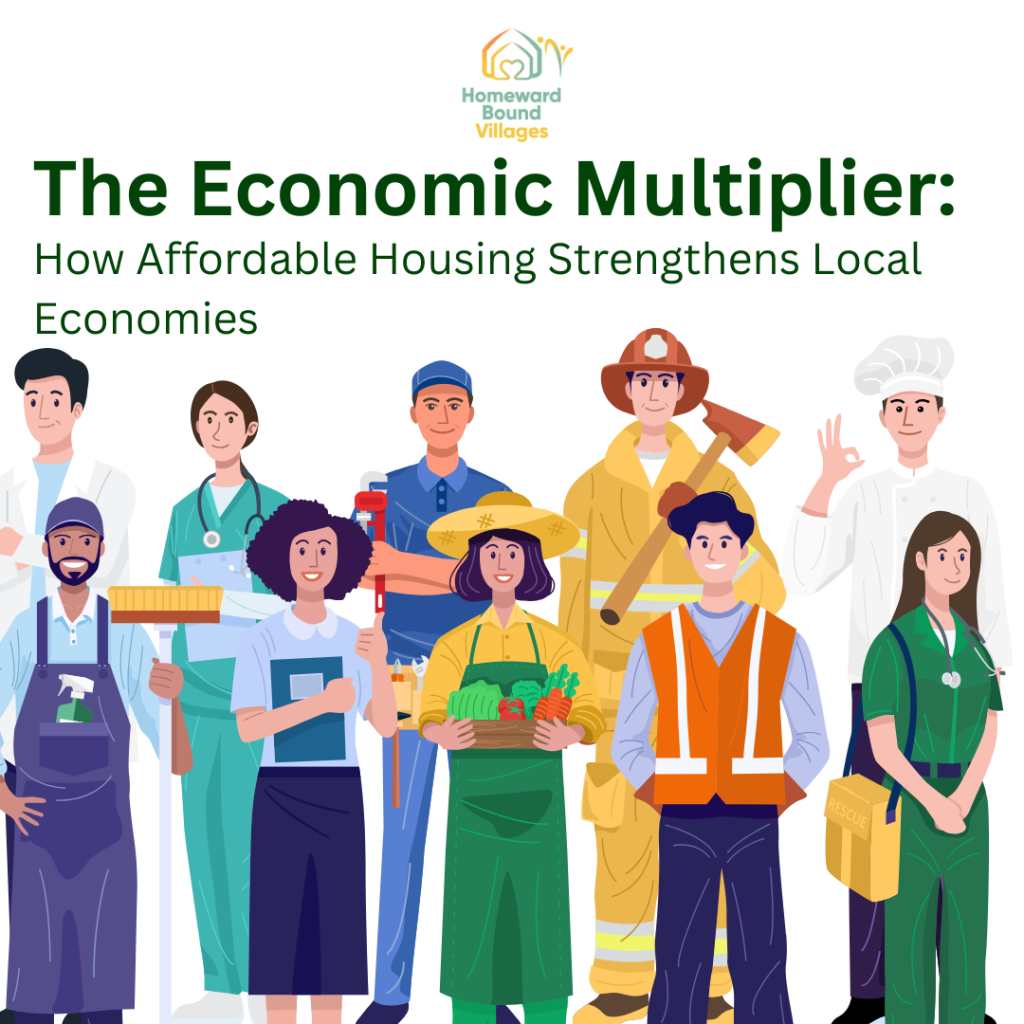
In Indiana, where the median household income is around $69,500, these benefits primarily help working families who form the backbone of local economic activity, such as healthcare workers, teachers, retail workers, and service-industry employees.
When essential workers can afford housing in the communities they serve, everyone gains from shorter commutes, stronger neighborhood ties, and improved economic resilience. The greater community benefits from the longevity and stability that affordable housing brings.
Investing in Shared Prosperity
Affordable cooperative housing is a form of strategic economic infrastructure. Each unit built creates jobs, supports local businesses, stabilizes neighborhoods, and helps households maintain their spending power that would otherwise be lost to high housing costs.
The economic multiplier effect means that housing investment benefits the entire community. By maintaining housing affordability, we’re not just helping individual families; we’re laying economic groundwork for shared prosperity, creating strong neighborhoods where working families can succeed and contribute to overall economic growth.