As we continue our series on housing policy in Indiana in 2025, we want to take a look at House Bill 1005, its intent, the realities, and some of the critical feedback.
For those who are following this topic, it is no secret that Indiana’s housing crisis has reached a critical point. With nearly half of renters cost-burdened and housing development struggling to keep pace with demand, state leaders are working toward housing solutions for Hoosiers. House Bill 1005, signed into law on May 1, 2025, represents an innovative approach: investing $25 million in infrastructure to unlock housing development across Indiana.
What HB 1005 Does
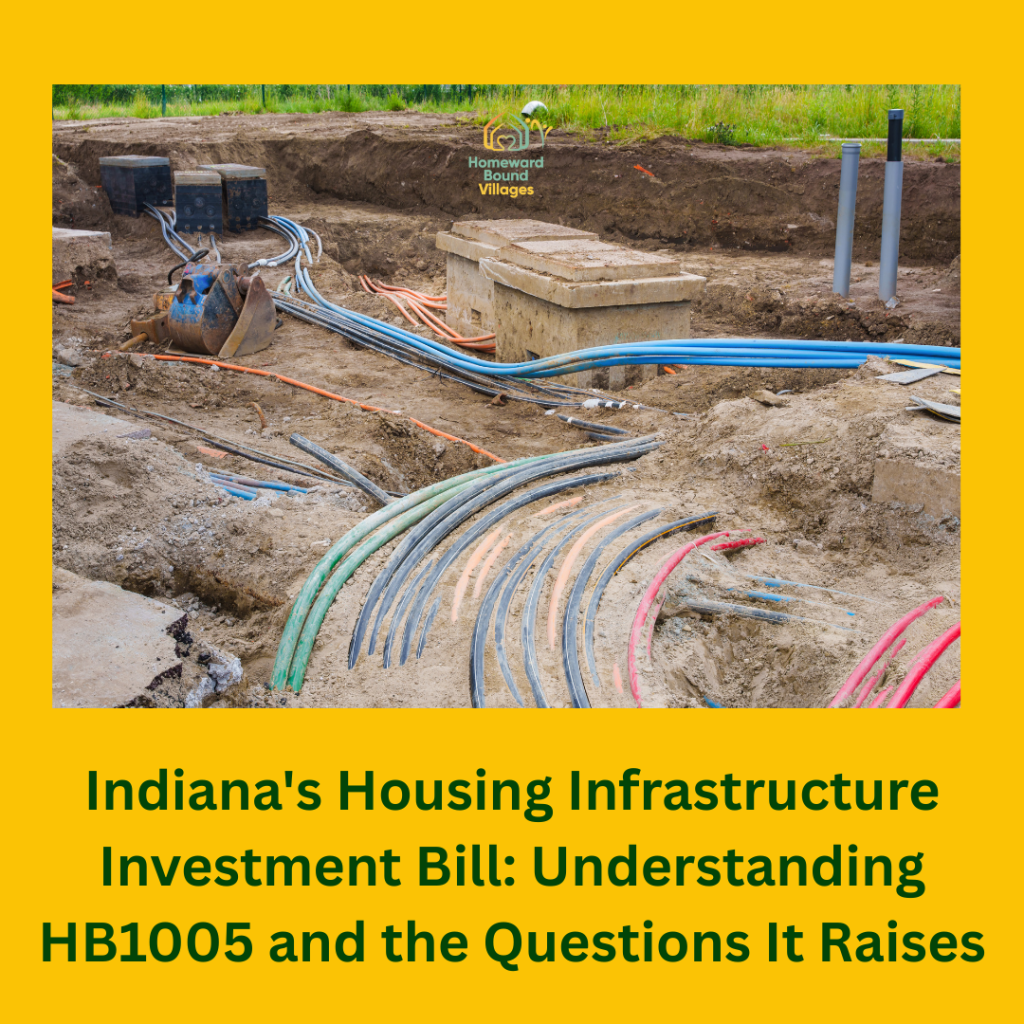
The law expands the Residential Housing Infrastructure Assistance Program, which provides revolving loans to local governments for infrastructure projects that support housing development, such as water and sewer lines, gas and electric connections, and other utilities that enable residential construction. The cost of this critical infrastructure can be a significant hindrance to affordable housing development.
The program’s history has been promising, with its first $82 million in funding supporting the development of approximately 3,350 housing units across Indiana. The new $25 million injection aims to continue this momentum.
The legislation also includes two key policy components:
- Priority for Pro-Housing Policies: Communities that adopt zoning reforms, such as allowing higher density, mixed-use development, and “missing middle” housing, receive priority in loan distribution.
- Third-Party Inspection Options: Local governments can allow qualified third-party inspectors to perform plan reviews and inspections, potentially expediting the permitting process.
The Supply-Side Theory
The underlying logic is straightforward: one reason housing costs are high is that supply hasn’t kept up with demand. When the median price for new construction ($379,000) is significantly higher than the overall median home price ($244,000), it implies that housing is too expensive to build. Infrastructure costs, which often account for 15-20% of total project expenses, are a significant barrier, particularly in rural and smaller communities.
By subsidizing these infrastructure costs, it is hoped that developers will be able to build more housing. More housing means more options, which should ease price pressure across the market.
The program has demonstrated its ability to produce housing. These housing interventions and infrastructure investments create lasting community assets.
The Affordability Question: Who Benefits?
In theory, with more housing being built, this should allow for movement in the housing market, renters becoming homeowners, and renters who are economically mobile to rent more expensive accommodations, thus freeing up more affordable housing. However, not all agree that the intended bill will provide housing solutions for those most in need.
The Deep Affordability Gap
Advocacy organizations, including Prosperity Indiana, have raised important questions about who this legislation actually serves. Their critique centers on a fundamental issue: the bill focuses on increasing overall housing supply. Still, it includes no specific criteria to ensure the resulting housing serves very low-income Hoosiers, the population facing the most severe shortage.
Let’s work the math for a family earning $19,000 per year, 30% of their monthly income means that rent should cost about $475 per month. Even if we bump that number up to $34,000 per year (LP County 2 person household 50% area median income), that’s only about $850 per month for rent and utilities. The broader housing market does not currently build housing at these price points.
When infrastructure assistance enables a new apartment complex with rents starting at $1,200, that’s helpful for moderate-income households. But it does nothing for the family choosing between rent and groceries. In fact, critics argue, it may make their situation worse by diverting limited resources toward housing that doesn’t serve those most in need, essentially building housing that will remain empty because not enough individuals can afford the rent.
The Wage Crisis Underneath the Housing Crisis
There’s a more profound critique of HB1005: Indiana’s housing affordability problem may be less about supply than about wages failing to keep pace with costs.
Independent analyses consistently show that the gap between what low-wage workers earn and what they pay in housing costs is widening. A full-time minimum wage worker in Indiana ($7.25/hour, or $15,080 annually) would need to spend nearly 80% of their income to afford a modest one-bedroom apartment at fair market rent.
If we view this through that lens, HB 1005’s supply-side approach addresses a symptom, not the underlying disease. You can build thousands of units, but if wages remain stagnant, the affordability crisis for low-income Hoosiers persists. The new housing serves those who can afford market-rate or near-market-rate rents, while the lowest-income residents remain locked out.
While easing supply constraints can prevent costs from rising further, it suggests that increasing housing supply alone is insufficient. Without parallel efforts to raise wages, expand rental assistance, or require affordability commitments in exchange for infrastructure subsidies, the housing that this bill is intended to create will not reach the people most in need.
Local Government Implementation Concerns
There’s also a practical question about how this will work on the ground.
Local government representatives, including Accelerate Indiana Municipalities (representing cities and towns), have expressed concerns about the third-party inspection provisions. Their worry: if local building departments still need to review third-party inspections, the process could actually create additional work rather than reducing it.
There’s also a revenue consideration. Building permit and inspection fees help fund local building departments. If third-party inspectors handle more work, local governments lose fee revenue but still maintain responsibility for ensuring code compliance.
These may seem like technical concerns, but they matter. If the streamlining provisions actually increase local burden or reduce capacity, the goal of faster housing production could backfire.
What’s Missing: Targeted Affordability Mechanisms
Looking at housing legislation nationally, several tools exist to ensure infrastructure investments result in housing serving lower-income residents:
- Affordability requirements: Mandate that a percentage of units in subsidized developments be affordable at specific Area Median Income (AMI) levels.
- Preference points: Give substantial scoring advantages to projects committing to deep affordability.
- Income-tiered subsidy levels: Provide more generous infrastructure assistance for projects serving lower-income residents.
- Community land trusts: Support models that permanently remove land from speculative markets.
HB 1005 includes none of these mechanisms. The priority given to pro-housing policies is valuable, but density and mixed-use development don’t automatically translate to affordability for very low-income households.
A More Complete Picture
What HB 1005 likely will accomplish:
- Enable the construction of several thousand housing units over the coming years.
- Reduce infrastructure barriers, particularly in smaller communities.
- Create incentives for zoning reform.
- Provide some relief to cost-burdened moderate-income households by increasing supply in their price range.
What HB 1005 most likely won’t accomplish:
- Directly address the housing needs of very low-income Hoosiers (under 50% AMI).
- Solve affordability challenges rooted in wage stagnation.
- Guarantee that infrastructure investments result in permanently affordable housing.
The Path Forward
Many agree that Indiana needs both supply-side and subsidy-side interventions. We need more housing across the spectrum, and we need dedicated resources for deeply affordable housing. We need infrastructure assistance, production subsidies, rental assistance and caps, and wage growth.
HB 1005 represents a meaningful investment in one piece of the puzzle. The risk is treating it as the whole solution. We hope that this bill is the first step in many over the coming years to support housing for all, including a focus on affordable housing for people at the lowest income levels. The housing crisis is complex; therefore, the solutions must be equally comprehensive.
Further Reading:
· Full text of HB 1005 (Indiana General Assembly official page)
· Prosperity Indiana’s 2025 General Assembly Recap
· Indiana Housing Dashboard (IHCDA – with county-level housing needs data and AMI analysis)
· Out of Reach 2025: Indiana (National Low Income Housing Coalition)
· The Gap 2025: Indiana Report (Analysis of affordable housing shortage for extremely low-income Hoosiers)