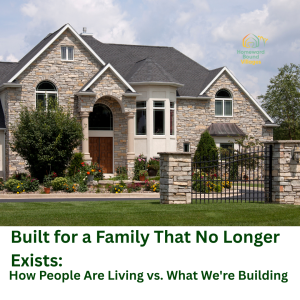
We’ve done multiple blog posts on how the construction industry builds homes the same way it did a century ago: large, mostly single-family homes. Meanwhile, the demographics of how people live and what they need have shifted. Smaller homes that leverage technology to build can bring housing solutions to market faster and more cheaply, and a handful of cities are already implementing this technology to make affordable homeownership a reality.
The Production Problem
In Post 1 of this series last week, we identified two main causes of the affordable housing crisis: a flawed system with skewed metrics used to define “affordable” and a mismatch in the types of homes being built. This post highlights the second issue and a solution already proving effective in several U.S. cities: factory-built, modular construction of small-footprint, owner-occupied homes.
The scope of the housing shortage is alarming. The National Low Income Housing Coalition’s 2024 Gap Report identified a nationwide deficit of 7.2 million affordable and available rental homes for extremely low-income renters. That number doesn’t include the even larger gap in owner-occupied homes priced within reach of the 60–80% Area Median Income (AMI) households who earn too much for subsidized housing and too little for the market.
Meanwhile, the tools for building differently have existed for decades but are being widely ignored. Modular construction, homes built in sections at a factory, then transported and assembled on a permanent foundation, currently makes up just 3% of newly completed multifamily buildings in the United States, according to 2024 U.S. Census Bureau data.
In Finland, Norway, and Sweden, factory-built homes make up 45% of residential construction. In Japan, the percentage is 15%. The U.S. isn’t lagging because the technology doesn’t work here; it’s because the incentive structures, financing systems, and zoning frameworks haven’t kept pace.
Why Modular Changes the Math
The case for factory-built homes is straightforward. According to a February 2024 report from the Center for American Progress, constructing low-rise multifamily projects off-site can reduce total costs by 20% compared to traditional on-site methods by cutting labor and build time. These savings are substantial in a market where developing affordable housing now costs between $100,000 and $750,000 per unit, and in competitive markets like California, it has surpassed $700,000 per unit with traditional financing methods.
Labor scarcity significantly drives up costs. The Associated Builders and Contractors estimated that the construction industry needed 342,000 additional workers beyond normal hiring in 2024 just to meet demand. Factory-based construction reduces dependence on skilled tradespeople by bringing workers into a controlled facility with consistent workflows. Fading West Development, based in Buena Vista, Colorado, employs about 110 factory workers earning between the low and high $20s per hour, stable, community-oriented jobs built around a repeatable production model.
That model isn’t foreign to us locally either. The Elkhart-Goshen metro had the highest concentration of production occupations of any metro area in the United States as of May 2024, according to the U.S. Bureau of Labor Statistics, with 32.8% of all employment in production work. The region is already home to major manufactured and modular home producers, including Skyline Homes and Cavco. The workforce, the supply chain, and the manufacturing infrastructure are here. The policy framework to direct that capacity toward affordable homeownership is what’s missing.
Beyond cost, modular construction provides a speed benefit that directly affects households waiting for housing.
The Right Home in the Right Form Factor
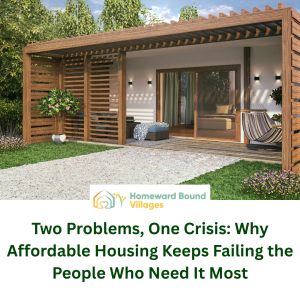
The form factor is as important as the construction method. The homes missing from the housing market aren’t large; they are small, efficient, standalone, and built for long-term ownership rather than short-term renting. For households earning 60–80% AMI, the goal is a 550–750-square-foot owner-occupied home on a solid slab foundation, using alternative materials and high-performance design to cut both construction costs and ongoing utility bills.
This is not a new concept. Chattanooga Neighborhood Enterprise (CNE) in Tennessee has a proven track record of constructing 532-square-foot cottages for homeownership in neighborhoods undergoing revitalization, featuring one bedroom, a full bath, 10-foot ceilings, and a fenced backyard, priced at $79,999 and affordable to someone earning $12 an hour. In San Antonio, BCL of Texas built 500–800-square-foot homes in a lower-income neighborhood near downtown, specifically targeting existing renters working in the service industry who are at risk of displacement due to gentrification.
The total cost of occupancy is the accurate metric here, not just the purchase price. A well-insulated, energy-efficient small home in the 550–750-square-foot range can offer monthly housing costs, including mortgage, utilities, and maintenance, that are equal to or lower than market-rate rent for a comparable space. That is the calculation that matters for a household at 60–80% AMI, weighing rent versus ownership.
Where It’s Working Right Now
These are not hypothetical; these are working programs with documented results.
Fading West Development — Buena Vista, Colorado
Fading West built a modern factory, covering the area of two-and-a-half football fields, in 2021, funded by four private investors and Colorado state loans. The U-shaped facility has 18 workstations, each assigned to a specific task, with homes moving through on-air casters every 4 hours. Their modular homes, including single-family houses, townhouses, and apartment complexes, are fully finished at the factory and assembled on-site on permanent foundations. The town of Buena Vista, Colorado, where Fading West is headquartered, became a documented case study in how a small municipality can use factory-built construction and partnerships with local producers to develop a workforce housing pipeline. After the 2023 Lahaina, Maui wildfire destroyed nearly 2,000 homes and claimed 102 lives, Fading West produced 82 modular homes for displaced residents in coordination with FEMA.
Denver West Holden Place — Denver, Colorado
The Modular Building Institute highlighted the West Holden Place project in Denver’s Sun Valley neighborhood in its May 2025 coverage of innovations in affordable homeownership. The 77-unit development serves households earning 80–120% of AMI and was funded through a partnership among the City and County of Denver, the Colorado Department of Housing, and the Colorado Housing and Finance Authority. The project showcases a fully integrated funding model for workforce-level modular housing in an urban infill setting.
City of Cleveland Modular Initiative — Cleveland, Ohio
In July 2025, the City of Cleveland announced it had secured a site for modular housing production and named finalists for what it called a transformative housing initiative. The project signifies a direct municipal investment in factory-built housing capacity and a public-sector commitment to establishing production infrastructure in a city with documented affordable housing needs.
MOVE-IN NY — New York State
In September 2025, Governor Kathy Hochul announced the MOVE-IN NY program through the New York State Homes and Community Renewal office, highlighting modular homes as a key part of the state’s plan to boost affordable homeownership statewide. The program marks a shift at the state level from viewing modular housing as a niche experiment to integrating it into mainstream affordable housing policy.
Seeds of Promise / InnovaLab Development — Michigan
In Michigan, nonprofit Seeds of Promise partnered with modular enterprise InnovaLab Development on two projects: a 25-unit community in Rapids City and a 20-unit community in Muskegon, both aimed at helping low-income households. The partnership model, a community-focused nonprofit working with a modular manufacturing partner, is a flexible structure that can be repeated in markets where neither party alone would have enough capital or capacity to carry out the projects.
Factory OS — Vallejo, California
Factory OS, located on Mare Island in Vallejo, had produced 2,400 housing units across 20 developments as of 2022. Most were built for nonprofit clients developing affordable housing, with about half providing supportive housing for formerly unhoused individuals. Factory OS exemplifies a modular producer whose entire business model is focused on affordable, mission-driven development rather than market-rate development.
The Barriers That Remain
The case for factory-built construction is strong. The barriers to scale are real and documented.
Financing structures do not match modular production timelines. Traditional construction financing disburses funds through draws linked to on-site progress milestones. Modular construction requires upfront investment in labor and materials at the factory before anything appears on site, meaning developers often need significant upfront capital before the financing system recognizes the work being done. The Center for American Progress recommends restructuring federal construction financing models to provide substantial funding during the initial factory production phase.
Building codes are still fragmented, adding another challenge. While modular homes built to state and local codes are legally equal to site-built homes, the codes differ greatly across different areas. A modular manufacturer operating in multiple states must follow different code systems, adding complexity that slows production and increases costs. CAP suggests that states with similar housing issues should work towards creating uniform building code rules for modular construction to help manufacturers streamline production.
Zoning continues to present some of the biggest obstacles, including minimum lot sizes, minimum square footage requirements, design standards that assume traditional construction, and outright bans on manufactured housing in many areas. Post 3 of this series will discuss those barriers directly.
Despite these obstacles, the path forward is clear for those willing to see it. The Canadian federal government allocated $500 million in its 2024 budget for modular and innovative construction developers as part of a national housing strategy. New York State launched MOVE-IN NY. Cleveland is investing in production infrastructure. Fading West reached $50 million in revenue. The question is no longer whether factory-built construction works for affordable housing; it’s whether the policy infrastructure will keep pace with existing production capacity.
What This Means for Communities Like Ours
For smaller markets, cities, and regions like northwest Indiana, the modular model offers something that conventional construction does not: an entry point that doesn’t require significant capital buildup before building even a single home. A small-footprint, factory-made home on an infill lot, financed through a CDFI and held in a community land trust (which we’ll speak more about in a later blog post), can be delivered more quickly, at lower cost, and with greater long-term affordability than anything the conventional development market is currently providing for households at 60–80% AMI.
The production answer exists and is currently used in various locations, including Buena Vista, Colorado; Denver’s Sun Valley neighborhood; Muskegon, Michigan; Vallejo, California; and New York State. The gap between what is possible and what is being implemented at scale is not a technology issue; it is a matter of policy, financing, and zoning, all of which are solvable.
Post 3 of this series, our next blog post, will examine exactly how zoning became the most effective barrier to the kind of housing that could actually close this gap, and what communities that have reformed it are seeing as a result.
Sources
National Low Income Housing Coalition, The Gap: A Shortage of Affordable Homes (2024). NLIHC.
U.S. Census Bureau, Characteristics of New Housing, 2024. Cited in J.P. Morgan, “A Modular Construction Solution for Affordable Housing,” 2025.
Michela Zonta, “Increasing Affordable Housing Stock Through Modular Building,” Center for American Progress, February 2024. Finland/Norway/Sweden/Japan market share figures cited in the CAP Fact Sheet at https://www.americanprogress.org/article/fact-sheet-using-modular-building-to-increase-affordable-housing-stock/.
Leo Miranda, “Modular Construction Is on the Rise. Can It Build High-Quality Affordable Housing?” Next City, August 2024. Per-unit cost range and California figures sourced from a 2018 governmental report cited therein. Charles Bloszies quote and Canadian $500M investment sourced from this article.
Eric Schaefer (Chief Business Development Officer, Fading West), quoted in “10 Tons, Built in Seven Days, and Maybe a Way to Restore the American Dream of Affordable Homeownership,” CNBC, September 2025. Lahaina/FEMA modular deployment and Buena Vista factory details sourced from this article.
“Nonprofits Put Small-Footprint Homes to Versatile Use,” NeighborWorks America. Chattanooga Neighborhood Enterprise cottage details and BCL of Texas / Rising Barn San Antonio project sourced from this article. Note: NeighborWorks has not published a date on this page; verify currency of CNE and BCL programs before publication.
“Affordable Housing Now: The Industry’s Best Bring New Solutions to World of Modular,” Modular Building Institute, May 2025. Denver West Holden Place project details sourced from this article.
City of Cleveland, “City of Cleveland Secures Site for Modular Production, Announces Finalists for Transformative Housing Initiative,” July 2025.
New York State Homes and Community Renewal, MOVE-IN NY program announcement, September 2025.
Seeds of Promise / InnovaLab Development Michigan projects cited in “Are Sleek Modular Homes the Future of Affordable Housing?” Reasons to Be Cheerful, May 2024.
Factory OS production figures from San Mateo County Office of Sustainability, “Modular Construction for Affordable Housing,” May 2024.