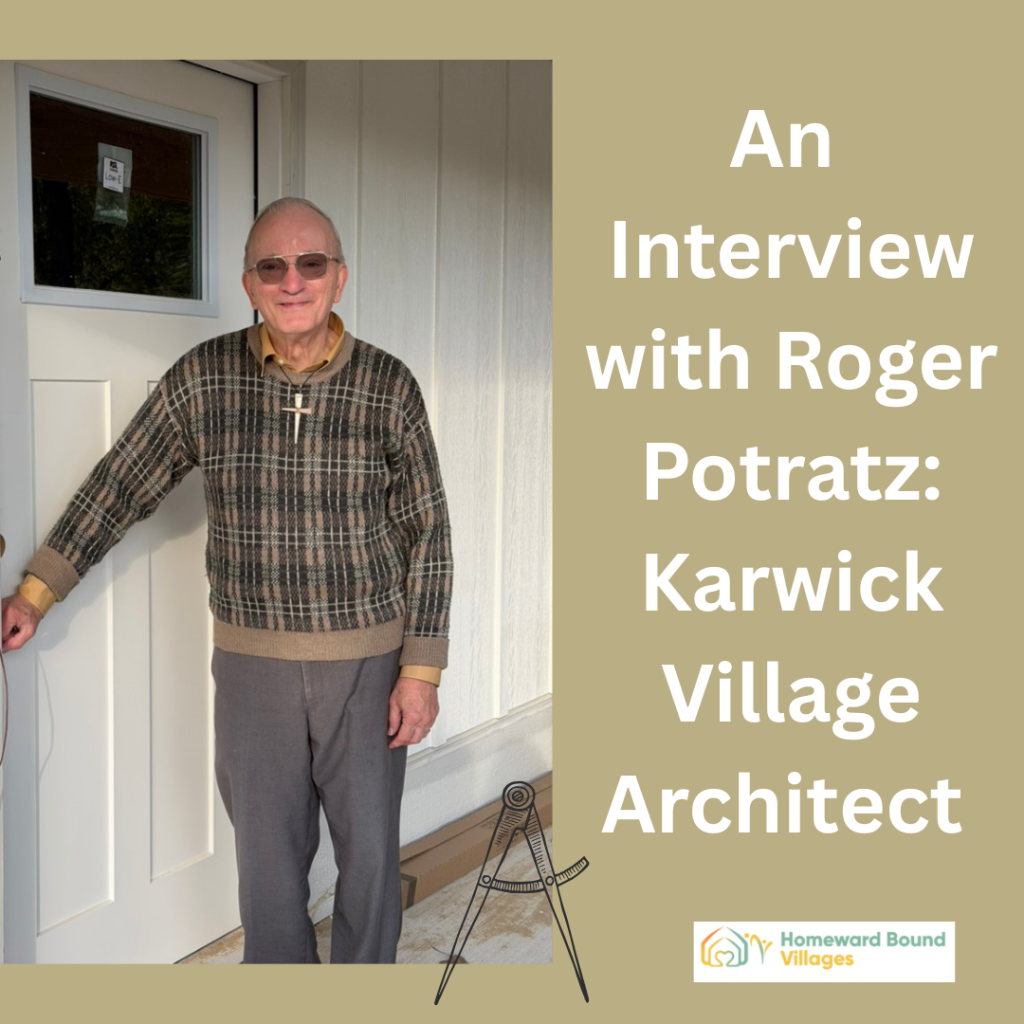
Roger is the architect behind the unique and beautiful residential tri-plex homes at Karwick Village. He has been involved with Homeward Bound Villages since its inception. As we explored various locations for our first project, Roger provided countless hours of consulting, along with conceptual site layout and architectural designs.
Late last week, we had the opportunity to sit down with Karwick Village Roger Potratz to talk about his work on the Karwick Village project, his history as an architect, and what drives his passion for architecture. We want to thank Roger and his lovely wife Pat for taking the time to join us onsite at Karwick Village for an interview.
We hope you enjoy this very special interview.
How did you first get involved in this project?
“The people in the community here know that I’m concerned about energy consciousness. I knew a couple of people who were on the committee, and either they contacted me or I contacted them—I forget which. I wanted to be sure that energy considerations were taken into account when this was being done.”
The design of the units is very efficient and thoughtfully designed, so that while the footprint is smaller, it remains more than adequate. Can you talk about that?
“There was a requirement that we not exceed a certain square footage, and that really drove the design. We optimized the space as much as we could using 2×4 construction. We don’t have a basement under these, so that saves some costs. If we could have done a little bit more energy-wise, it would have been nice, but there’s got to be a breaking point.”
All of the buildings face inward towards each other. Could you discuss that design choice?
“Oh yeah, that’s the village idea. You don’t want to look at somebody’s back when they walk out the door. It’s a village—you want to see your neighbor’s face, not their back. It helps with being neighborly.
This project has such a beautiful, intentional design. So often, affordable housing prioritizes function over beauty, energy efficiency, and community layout.
“That’s what we wanted to try to get away from, because so many subdivisions—not only here, but out in Nebraska, where I now live—it’s one building after another, all looking the same. Now, these do look the same, but there aren’t so many of them. And there is some movement in the plan where one building is projected out farther than the other—it’s not just flat across. And then you have these porches in front, which help an awful lot.”
Can you tell me about your professional history as an architect?
“I graduated from the University of Oklahoma in 1966 with a Bachelor of Architecture degree. At that time, the profession required a mandatory three years of apprenticeship, working hopefully for more than one architect to get a range of experience. That’s what I did. We’ve moved some 14 times since then, but it did give you a real, rounded base in the field. I was never really one to design big skyscrapers—residential was more my way. Family work, you know.
We were here in Michigan City for 35 years. We moved here from Lander, Wyoming. I got involved with the city planner in Lander, and he had gotten in contact with HUD—Housing and Urban Development. They were offering, back in 1984, a program granting payment for the design of energy-conscious design using solar, because there’s a lot of sun in Wyoming.
I had the opportunity to do two different designs. One called a convective loop design, the other was a hybrid. The hybrid is closer to this project, where you would have glass where these poles are, and you’d walk into a greenhouse every time you come home. You’d walk through the greenhouse to get to the home.
At the top of the greenhouse would be a fan, and when the temperature got up to like 90 degrees or more, it would take the air and push it down through a series of ducts into the floor, across to what was actually large gravel about two feet deep, with a perforated PVC pipe through it so that the air came down and pushed through the pipe. The stones around it weren’t fitted together tightly, so the air could flow through.
Those homes were 1,400 square feet with two bedrooms down and one large bedroom up with the greenhouse. Back in 1984, we built them for $40,000, and they were designed to provide a minimum of 30% savings in energy costs. The plans are still available to the public because they were grant-funded.
It’s interesting—about five years ago, I had the opportunity to talk to a couple of ladies who owned one of those houses. I guess you just can’t please everybody, because one of them didn’t like it at all, and the other just thought it was the greatest thing in the world.”
What trends have you seen over your 30-plus years in architecture? What trends have you liked, and which ones don’t you care for?
“What I don’t care for is that too many look the same—cookie-cutter. You come home at night and think, “Which one of these homes is mine?” You literally have to count them.
Good things: similar materials like this—materials with a wood grain that are substantial and will last a while. The insulation qualities have improved primarily because the government has kind of pushed to get it done that way. If we manage our energy consumption, it starts here.
More metal roofs now, and they last twice as long. And more porches, though porches are not designed the same as they were at the turn of the century. Back then, you had a porch in the front because when people walked by, the lady could come up and have a cup of coffee, and you had a porch to sit on. At the turn of the century, your porch was a whole other room because you didn’t have central air, so it would be easier to go out on the porch in the evening and catch the breeze than stay in the house. There was something to be said about being neighborly—even in neighborhoods where you didn’t have a porch, maybe you just had a stoop, you’d go sit out on the stoop.
That’s one of the nice things about this community—all of these units have really generous porches. You could put a bench out here, or a little table, or flower pots. Really lovely, intentional design.”
For people who are going to read this interview, is there anything I haven’t asked you about this project that you would like people to know?
“We are doing some recreational-type space, which is good. So if somebody does one of these again, don’t neglect that [shared] space.
On this one, we chose to go with one building where everybody could share for laundry and what have you. There’s something to be said about creating community, though. As everybody comes together in one building and shares resources, you might be passing your neighbor with their laundry, or perhaps there’s a knitting group taking place in the main room, and maybe there’s a skill you want to learn. But see, that’s what these porches are for, too.
There’s one thing about being an architect that you can’t make money for. I stopped at a house that I did a major addition and remodel on—I think it was before this project. I walked up to the front door, and the owner was, of course, surprised to see me coming from Nebraska. But she was just ecstatic with how good the house works and how great it looks. That gets you right here [pointing to his heart]. It’s an intangible thing you can’t put a dollar amount on. It’s what makes you keep going.
You create spaces where people live their whole lives and make memories. And the other major part of architecture that I do—I’ve done a number of churches, and that’s the other part that I enjoy very much doing.”
We want to extend our heartfelt gratitude to Roger and his wife Pat for taking the time to tour Karwick Village and to Roger for sharing his inspiration, history, and design ideas with us.