The term “affordable housing” is used frequently these days. Some use this term correctly, while others do not fully comprehend the actual definition of what qualifies a home as affordable. Today, we are going to share what the term affordable actually means in the housing conversation, and what it does not mean.
What Is Affordable Housing?
The U.S. Department of Housing and Urban Development (HUD) defines affordable housing as housing on which the resident spends no more than 30 percent of household income on housing costs, including utilities. This 30 percent threshold, which became the federal standard in 1981, is intended to ensure households have sufficient income for other necessities, such as food, healthcare, transportation, and childcare. Households that spend more than 30 percent of their income on housing are considered “cost-burdened,” while those exceeding 50 percent are labeled “severely cost-burdened”. According to Housing4Hoosiers, a program of Prosperity Indiana, housing is considered affordable when individuals spend approximately 30 percent of their income on rent and utilities.
What Affordable Housing Is Not:
Not “Low Quality”
There is a long-held notion that modern affordable housing is only purpose-built, done cheaply, and maintained poorly. Put simply, these homes are not places one would want to live. This is simply not true; affordable housing can be beautiful, comfortable, and simply lovely. Today’s affordable housing can offer contemporary design, energy-efficient systems, and community amenities.
Only For Unemployed Individuals
Most residents of affordable housing hold multiple jobs. They’re cashiers, CNAs, childcare workers, and maintenance staff. This crisis isn’t about unemployment; it’s about wages that haven’t kept pace with housing costs and housing costs that have skyrocketed.
Not a Community Burden
Well-managed affordable housing:
- Does not negatively impact property values.
- Reduces strain on emergency services.
- Supports local businesses by keeping workers nearby.
- Creates construction jobs and ongoing employment.
- Contributes to property tax revenue.
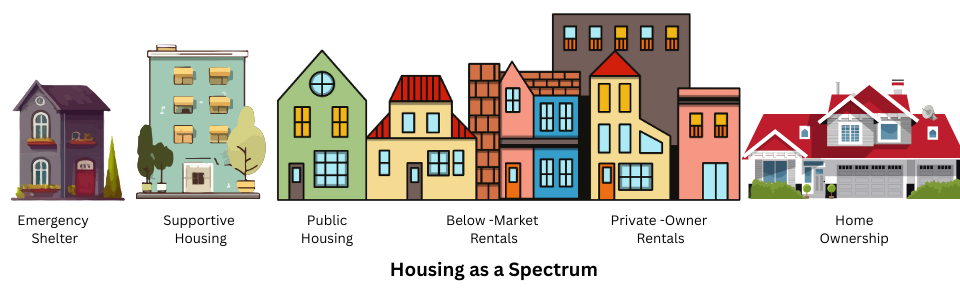
Not Emergency Shelters
Affordable housing is permanent, stable housing where people build their lives. Emergency shelters provide temporary crisis intervention. These are different points on the housing continuum.
Why Communities Need Affordable Housing
Affordable Housing Keeps Communities Running
Our local economy depends on workers across all income levels. When teachers, EMTs, and healthcare aides can’t afford to live where they work, businesses struggle to find employees, and experienced workers move away.
Stability Creates Opportunity
When families aren’t spending more than 60% of their income on housing, they can save for emergencies, afford healthcare, invest in education, and contribute to the local economy.
Prevention Reduces Homelessness
Affordable housing is one of the most effective tools in ensuring individuals do not become unhoused.
Diversity Strengthens Communities
Economically diverse neighborhoods maintain vibrant businesses, diverse civic engagement, and the social fabric that makes communities resilient.
Common Misconceptions About Affordable Housing
Property Values?
Decades of research show that well-maintained affordable housing does not negatively affect surrounding property values. Studies from NYU’s Furman Center and others find no measurable negative impact, and sometimes even small positive effects.
Safety?
Crime correlates with instability and lack of opportunity, not with affordable housing. Stable, well-managed housing can often reduce crime by addressing root causes. Access to affordable housing provides stability beyond housing.
Schools?
Children in stable housing attend school more regularly and perform better academically. This creates healthier, more well-educated families that build success for brighter futures.
Affordable housing belongs in All Communities:
Affordable housing isn’t about “those people” or “that kind of housing.” It’s about ensuring that the people who make our communities function can afford to live here. Affordable housing benefits not only the residents who call these dwellings home but also the entire community.
A teacher earning $45,000 shouldn’t have to choose between safe housing and saving for their children’s future. That’s not sustainable for families or communities.
How Can You Support Affordable Housing in Your Community?
- Educate yourself and challenge misconceptions.
- Attend local meetings when housing is discussed.
- Support organizations expanding affordable housing.
- Advocate for policies that prioritize affordability.
At Homeward Bound Villages, we create high-quality, co-operative, affordable housing that allows our residents to thrive. Because everyone deserves a safe, stable place to call home, and our entire community benefits when that’s possible.