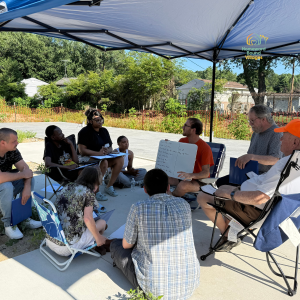

Federal funding, state tax credits, and legislative sessions often get the headlines when it comes to housing policy. However, many fail to realize that the decisions that most directly determine whether a home can exist on a given piece of land are made much closer to home: at a plan commission meeting, on a weeknight, in a room with plenty of empty chairs.
Zoning maps, lot size minimums, parking requirements, permit timelines, and fee schedules rarely get described as housing policy, but they are. These pieces coincide to decide what can be built, where, how quickly, and at what cost. In Indiana, nearly all of them are controlled by the people communities elect locally and the neighbors they appoint.
The Size of the Gap
According to Prosperity Indiana and the National Low Income Housing Coalition, Indiana has 34 affordable and available rental homes for every 100 extremely low-income renter households, a shortage of 138,137 homes statewide. A full-time worker needs to earn $24.13 an hour to afford a modest two-bedroom apartment at the state’s average fair market rent of $1,255.
No single program closes a gap that size. It closes when many communities make it legal, practical, and affordable to build more kinds of homes. That work starts with land use.
Who Decides in Indiana
While each state is different, Indiana law grants planning and zoning authority to counties, cities, and towns under Indiana Code 36-7-4. However, the structure is nearly the same across the state. A plan commission prepares the comprehensive plan and recommends zoning changes. The legislative body, meaning the city or town council or the county commissioners, adopts the zoning ordinance and the zoning map. A board of zoning appeals hears requests for variances and special exceptions.
Each of those bodies meets in public and takes public comment. In most communities, the people who show up are the ones who want to stop something. That is a big reason the rules look the way they do.
Lever One: What Can Be Built, and Where
In much of Indiana, most residential land is zoned for one detached house per lot. Duplexes, triplexes, fourplexes, cottage courts, and accessory dwelling units (a small second home on the same lot, such as a garage apartment or backyard cottage) are either prohibited or permitted only after a hearing. These are the housing types that working families, older adults, and young people starting out have historically relied on, yet local codes most often rule them out.
A council can change that with an ordinance. South Bend did. In 2020, the city adopted a new zoning code that legalized “missing middle” housing like duplexes so that builders could add homes on vacant lots in existing neighborhoods. More than 50 infill homes have since been completed in its Near Northwest neighborhood alone, most of them affordable to households at or below the area median income, according to Results for America.
Lever Two: The Fine Print
Even when a housing type is technically allowed, dimensional standards can quietly make it impossible. Large minimum lot sizes, deep setbacks, garage mandates, height caps, and off-street parking requirements all add land and construction costs to every unit. On a small infill lot, two required parking spaces per unit can be the difference between four homes and one home.
South Bend removed minimum parking requirements citywide in 2021, opening possibilities for infill housing in the city.
Lever Three: The Process Itself
The saying ‘time is money’ rings true when it comes to housing. Every month a project waits for a hearing adds carrying costs, and every discretionary approval is a chance for a project to be reduced or denied. Small local builders and nonprofits feel this the most, because they have the least cushion.
Communities control this too. They can allow more housing types “by right,” which means a project that follows the rules gets its permit without a special hearing. They can publish clear checklists and set review deadlines. South Bend went a step further and created a catalog of pre-approved building plans, so a builder can select a design the city has already reviewed.
Lever Four: Fees, Infrastructure, and Financing
Permit fees, impact fees, and the cost of extending water, sewer, and streets all factor into a home’s final price or rent. Indiana gives local governments several tools. Residential tax increment financing allows a community to use new property tax revenue from a housing development to pay for the infrastructure that serves it. As of July 2026, those programs can run for up to 25 years instead of 20. The state’s residential housing infrastructure fund now directs 70 percent of its loans to communities with fewer than 50,000 residents, including every city and town in La Porte County (Indiana General Assembly).
Tax abatements, publicly owned land, and the conversion of vacant commercial buildings into homes are also local decisions. None of them requires a new state or federal program. Each requires a local vote.
What Indiana Does Not Allow
Honesty about the limits matters. Indiana Code 36-1-24.2-1 prohibits counties and municipalities from adopting land use rules that control rents or sale prices, or that require property to be reserved for residents based on income. Mandatory inclusionary zoning, a common tool in other states, is off the table here.
That makes the supply-side levers above even more important, not less. It also raises the stakes for the mission-driven developers, nonprofits, and community partners who choose to build affordable homes voluntarily, as well as for the local governments that choose to make room for them.
The New State Law Puts This on Every Local Agenda
This year the General Assembly passed House Enrolled Act 1001, signed by Governor Braun in March as Public Law 73. Early versions of the bill would have limited local rules on lot sizes, design standards, parking, and accessory dwelling units statewide. After strong objections from local officials (Davies), the final version took a different approach: it left decisions local and put local governments on the clock.
Under the new law, every county, city, and town that exercises zoning power must hold a public hearing by January 1, 2027, to review its development ordinance and zoning rules with the goal of increasing housing. The law lists what that review should consider, including allowing duplexes, triplexes, and fourplexes; allowing accessory dwelling units and other housing types; converting commercial buildings to residential use; and waiving or eliminating rules on lot size, setbacks, garages, parking, design standards, and height. Each community must send the results to the Legislative Services Agency (Indiana General Assembly).
The law also creates the state’s first statutory definition of an accessory dwelling unit, limits permit fees to the actual cost of review starting in 2027, sets deadlines for permit decisions, and requires annual local reports on homes proposed, approved, denied, and built, along with local prices and rents. This means communities have been given the first move. If they do not use it, the state has signaled it may make the next one.
Your Seat at the Table
Here is what that means for anyone who cares about housing in La Porte County, or anywhere in Indiana. Sometime between now and January 1, communities must hold a public hearing on exactly the questions in this post. It will be on an agenda. It will be open to you.
Find out when it is. Call your planning department or check your council and planning commission agendas. Then show up, or send a written comment, and say what is almost never said in those rooms: yes. Yes, to the duplex, yes to the backyard cottage, yes to homes on the empty lot, yes on my street.
Housing policy is not only made far away by people you will never meet. A great deal of it is made down the street by people, fellow neighbors and community members. The levers are local. So is the opportunity.
Other Posts in this Series:
Who’s Actually Becoming Homeless: Families, Older Adults, and the Priced-Out
The 2025 Count in Context: Indiana’s Rising Homelessness by the Numbers
We Can’t Cite Our Way Out of Homelessness: Why Criminalization Fails
Indiana Bill SEA285: What It Means Now That It’s in Effect
The Federal Retreat From Housing: What the Latest Funding Cuts Mean for People at Risk
Sources:
Indiana General Assembly, House Enrolled Act 1001 (Public Law 73, 2026)
Indiana Code 36-7-4, Local Planning and Zoning
Indiana Code 36-1-24.2-1, Prohibition on Local Rent and Price Controls
National Low Income Housing Coalition, 2026 Indiana Housing Profile
Results for America, “Spurring Infill Housing Development: South Bend, IN”