
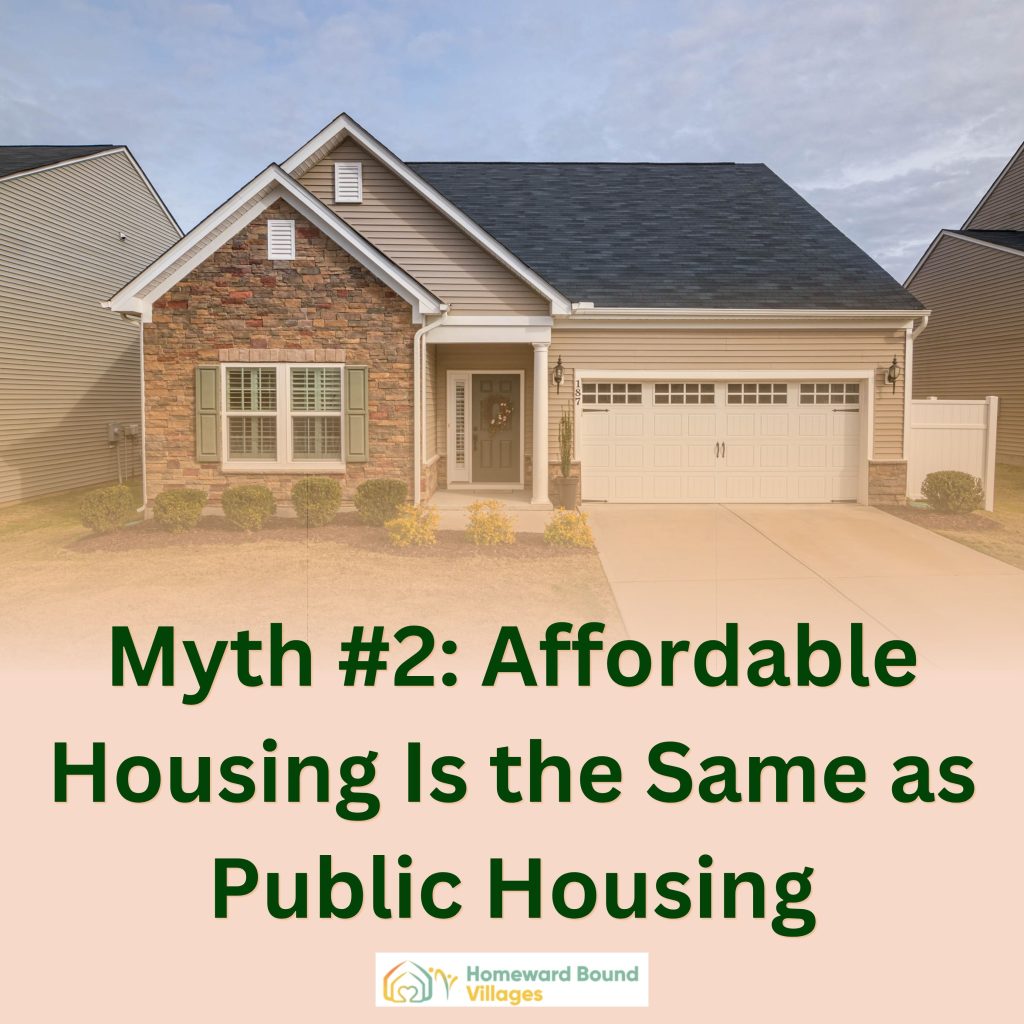
April is Myth-Busting Month, as we work to break common misconceptions about affordable housing at Homeward Bound Villages. All month long, we are challenging the assumptions that block progress on one of La Porte County’s most urgent needs, affordable housing. But La Porte County is not alone; affordable housing is at crisis levels across most of the country.
The terms affordable housing and public housing are used interchangeably in conversations, community meetings, and the news. Affordable housing. Public housing. Low-income housing. For many, these terms mean roughly the same thing. However, this is not true, and the confusion matters because it shapes how communities respond and has far-reaching implications.
Understanding the difference is not just a terminology exercise. It is the foundation of an honest conversation about housing in La Porte County and across our country.
What Public Housing Actually Is
Public housing is a specific federal program. It refers to residential units built, owned, and managed by local government housing authorities, funded by the U.S. Department of Housing and Urban Development (HUD). According to the Council of Large Public Housing Authorities, there are approximately 1.1 million public housing units in the United States, managed by more than 3,000 housing authorities.
These developments are entirely government-owned. Residents typically pay rent that is around 30% of their income, with the federal government subsidizing the rest. Public housing has a complex and specific history in the United States, heavily influenced by decades of federal disinvestment. The Council of Large Public Housing Authorities reports that over 250,000 public housing units have been lost since 1995, primarily due to the demolition of properties that became uninhabitable after prolonged funding cuts. That history and those images are what most people associate with the term “affordable housing.”
What Affordable Housing Actually Is
Affordable housing is a much broader term that encompasses a wide range of housing types, funding models, and development approaches, most of which are unrelated to government ownership. According to the National League of Cities, affordable housing generally refers to any home, rented or owned, in which costs make up no more than 30% of a household’s monthly income. That definition covers everything from market-rate apartments that happen to be affordable to a particular family to privately developed rental communities built with tax-credit financing to cooperative rental models like the one at Karwick Village.
The most significant financing tool for affordable housing development in the United States is the Low-Income Housing Tax Credit, administered by state housing agencies and funded through private investment. Properties developed through this program are privately owned and managed, not government-owned
According to HUD, this program has financed the construction or rehabilitation of more than 3.7 million housing units since 1987. These are privately developed, privately managed communities with built-in income restrictions. They are not government housing projects.
As Platform Group, an Illinois housing organization, puts it: while public housing is affordable, affordable housing is not public housing.
Why the Distinction Matters Here
Homeward Bound Villages is not a public housing authority. Our organization does not receive HUD operating subsidies and does not own properties on behalf of a government agency. Karwick Village is a cooperative community developed by a nonprofit organization (Homeward Bound Villages), financed through a combination of philanthropic giving, grants, local government investment, and community support. Residents of Karwick Village are cooperative members, not tenants of a government program. They have a stake in the community, a voice in how it operates, and access to permanently affordable housing through a cooperative ownership structure.
That is a fundamentally different model from public housing, and communities should clearly understand it before forming an opinion about what should and could be built in our communities in La Porte County.
The myth that affordable housing and public housing are the same thing is not just inaccurate. It leads communities to oppose developments that bear no resemblance to the thing they are worried about. Clearing up that confusion is one of the most important things we can do to move the housing conversation forward in La Porte County.
This blog post is #2 in our affordable housing myth-busting series. You can read blog post #1 in the series here: Affordable Housing Means Low-quality Housing
Sources
Council of Large Public Housing Authorities, Public Housing Facts: https://clpha.org/public-housing/facts
National League of Cities, What is Affordable Housing: https://www.nlc.org/article/2024/01/08/what-is-affordable-housing/
HUD, LIHTC Property and Tenant Level Data: https://www.huduser.gov/portal/datasets/lihtc.html
Platform Group, Affordable vs. Public Housing: https://platformrockford.org/affordable-vs-public-housing/