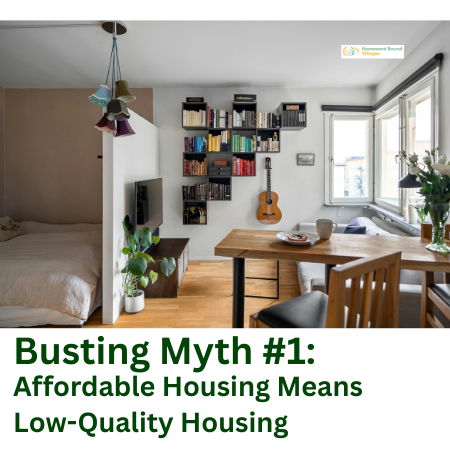
This month, we are dedicating our blog to Myth-Busting. Throughout the month, we’re challenging assumptions that block progress on one of La Porte County’s most urgent needs, affordable housing, but these myths don’t just occur in La Porte County. So let’s dig into myth #1: Affordable housing means low-quality housing.
For many, the words “affordable housing” quickly conjure up a picture of worn-down buildings and neglected landscaping. A place that looks like nobody cared enough to put time, money, or effort into creating a beautiful and affordable place to live.
This is one of the most persistent myths in housing discussions, and one of the most harmful. When people assume affordable means low quality, they oppose it in their neighborhoods, question whether it’s worth funding, and dismiss it before it ever gets a chance to prove them wrong. We spoke a little bit about this in our interview with exterior designer Molly Hannon, who provided the exterior and interior design at Karwick Village. You can read that interview here.
The reality is that when affordable housing is done right, it is well-built, thoughtfully designed, and maintained with pride.
Where the Myth Comes From
The most common myth comes from a specific period of American public housing, mid-century high-rise public housing that was underfunded, poorly managed, and eventually demolished in many cities. That part of housing history is real, and its failures were significant.
This myth that all affordable housing today has not changed from that mid-century image of public housing, with that history, is like judging every restaurant by a cafeteria you visited in 1987. The model and standards have changed. The proof exists in cities across the country and right here in northern Indiana. Affordable can be beautiful and uplifting for an entire community.
What Good Affordable Housing Actually Looks Like Today
The numbers tell the story even before the homes do. According to HUD, there are over 54,000 income-restricted affordable housing developments across the United States, comprising 3.7 million homes that are built to code, inspected, and required to maintain affordability standards for at least 30 years. These are homes that people care about.
Research from the Terner Center for Housing Innovation at UC Berkeley found that nearly 90% of affordable housing residents reported that their housing situation had stabilized after moving in. Residents consistently cited the quality of their unit, not just the rent, as a primary reason for staying.
The contrast becomes even sharper when you look beyond U.S. borders. In Vienna, roughly half of all residents live in subsidized housing, and the city continues to retrofit older buildings, add solar, and reinvest in quality over generations. Singapore’s Housing Development Board has built an entire national identity around public housing done right, with ongoing upgrading programs that keep older estates up to date. These aren’t one-time builds left to age out. They are permanent civic commitments, continuously maintained and invested in. We’ve written in depth about these international models and what the U.S. could learn from them; you can read that full piece here. The point of this myth is simple: when sustained investment is the expectation, not the exception, the result is housing that anyone would be proud to call home.
The United States has largely operated on the opposite assumption: build it, fund it minimally, and move on. The result is the very image that defines the myth. The examples we see in Austin and Santa Monica aren’t proof that great affordable housing is rare; they’re proof of what becomes possible when intentional design and continued investment are treated as non-negotiable, not optional.
Two examples from opposite ends of the country show that affordable housing can be beautiful, functional, and uplifting for the entire community.
In Austin, Texas, Mobile Loaves & Fishes created Community First! Village is a thoughtfully designed neighborhood offering affordable, permanent housing and a supportive community for men and women who were previously unhoused. It doesn’t resemble what most people imagine when they hear “affordable housing.” Homes are grouped around common areas, including laundry rooms, outdoor community kitchens, and front porches, intentionally designed to encourage neighborly connections. Architects were specifically hired for the project, and local builders provided the labor to bring those plans to life. Every choice was focused on what makes a truly good home: security, comfort, a place for your belongings, and the ability to express yourself. Residents could tour different homes and choose the one that best fit them. That’s not a compromise. That’s dignity built into the design.
The Michael & Susan Dell Foundation committed $36.6 million to fund the construction of 1,400 more homes at Community First! Village. Serious institutional investors won’t invest in something substandard. They invest in what works and what lasts.
Across the country, Pacific Landing in Santa Monica, California, is a net-zero-energy, LEED Platinum-certified, 100% affordable housing community that transformed a former gas station into a home for people living with disabilities and limited incomes. It received an American Institute of Architects Design Excellence Award. The community offers one- to three-bedroom residences with green spaces, a central courtyard, and all-electric energy systems that significantly reduce residents’ utility costs. LEED Platinum is the highest green building certification available in the United States. Affordable housing earning that designation isn’t taking shortcuts; it is an intentional choice.
These are not outliers. They are part of a growing national movement that has fundamentally changed what affordable housing looks like, how it performs, and how it feels for the people who call it home.
What We’re Building in LaPorte County
The same philosophy shapes every decision at Karwick Village. Our units are designed with a smaller footprint to enhance energy efficiency, and the materials and design choices were specifically made to be environmentally friendly and long-lasting. Smaller doesn’t mean lesser. It means smarter. Lower utility bills, less upkeep, and more resources directed toward what truly makes a home comfortable and a neighborhood worth living in.
Our first six units are fully occupied, creating intentional community through affordable housing. Each unit has a front porch that opens onto a shared village green. The community center planned for Phase 2 will serve as the heart of Karwick Village, a community kitchen, laundry facility, and gathering space designed to promote stability and independence. Shared amenities aren’t a sign that residents get less. They’re a strategic choice that builds exactly what the name promises: community.
See It for Yourself
There are more than 54,000 affordable housing developments across the United States, from Austin to Santa Monica to Michigan City, that are making the same argument with their walls, their windows, and the people who live inside them: affordable housing, built with intention, creates community.
Karwick Village demonstrates that affordable housing can be beautiful, community-oriented, and innovative, built on dignity and the understanding that housing is not a luxury but a foundation.
Phase 1 is nearly complete. Six families are home. And the community looks exactly like what it is: housing built with care, by people who believed it mattered, for neighbors who deserve nothing less.
The myth that affordability means low quality persists because most people have never seen the alternative up close. In LaPorte County and across our country, affordable housing is becoming a place anyone would want to live.