Are you new to the affordable housing discussion or in the fact-finding phase about this critical issue? You’re not alone. With so many acronyms, percentages, and policy terms, it can seem like everyone is speaking a different language when it comes to affordable housing. However, learning a few key concepts will help you follow local conversations and get involved in finding solutions for La Porte County and beyond. Today, we will cover many of the most basic terms and share a list of resources for further learning.
The Foundation: What Makes Housing “Affordable”?
Affordable Housing
Housing is deemed “affordable” when a household spends no more than 30% of its gross income on housing costs (rent or mortgage plus utilities). That’s it, the 30% rule is the nationally accepted standard for what families can reasonably afford while still having enough left over for food, healthcare, transportation, and other necessities. Quick example: If your household earns $3,000 per month, affordable housing will cost no more than $900 per month, including utilities.
Cost-Burdened
Households spending more than 30% of their income on housing are “cost-burdened.” These families often have to make impossible choices about which bills to pay; rent, groceries, medicine and medical care, or childcare. Nearly half of all U.S. renters are cost-burdened.
Severely Cost-Burdened
Households spending more than 50% of their income on housing are severely cost-burdened. One quarter of all U.S. renters fall into this category, meaning millions of working families are one emergency away from losing their housing.
Understanding Income Levels
Area Median Income (AMI)
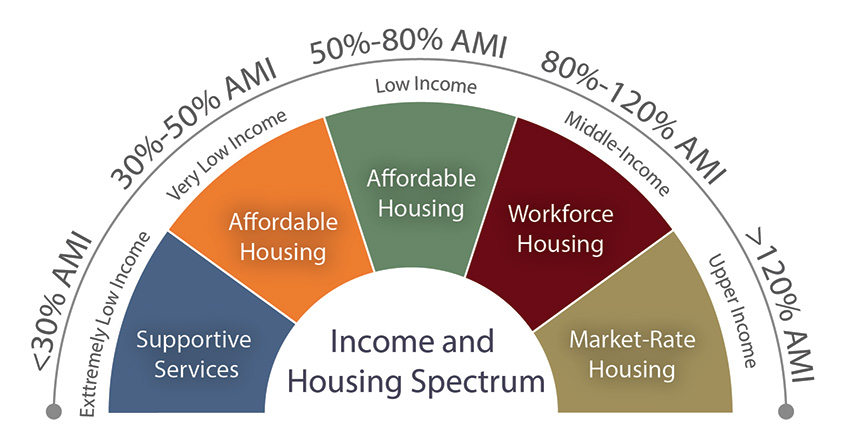
Don’t let the term intimidate you; AMI is simply the middle point of all household incomes in your area. Half of households earn more, half earn less. The U.S. Department of Housing and Urban Development (HUD) calculates this annually for every area, adjusted for household size.
The federal government uses AMI percentages to determine eligibility for various housing programs. When you see “housing at 60% AMI,” it means housing targeted to families earning 60% of the area’s median income.
Income Categories (What They Really Mean):
- Extremely Low Income (ELI): 0-30% of AMI
Think: someone on disability benefits or working a minimum wage job. - Very Low Income: 31-50% of AMI
Many full-time workers in service jobs fall here. - Low Income: 51-80% of AMI
Often includes nursing assistants, retail workers, and home health aides. - Moderate Income: 80-120% of AMI
Your teachers, nurses, police officers, childcare workers, and essential workers who earn too much for traditional affordable housing but still struggle with housing costs.
Here’s what matters: in La Porte County, many people working full-time in essential jobs fall into these categories. They’re working and contributing to our community, but their wages simply don’t cover housing costs. However, La Porte County is not alone; this is a significant issue across Indiana and the country..
Measuring Housing Costs
Fair Market Rent (FMR)
HUD’s estimate of what a household moving today can expect to pay for a modest rental home in a given area. It’s not luxury housing, just decent, safe, and modest. FMR is updated annually and is used to set payment standards for programs such as Housing Choice Voucher
Find your area’s Fair Market Rent
Housing Wage
The hourly wage a full-time worker must earn to afford a modest rental home at Fair Market Rent without being cost-burdened ( spending no more than 30% of income on housing).
In Indiana, the housing wage for a two-bedroom apartment is $22.18 per hour. But the average renter earns only $18.05 per hour, leaving a $4.13 gap that adds up to nearly three months’ rent over a year. This gap explains why so many working families struggle with housing, even when working full-time.
Explore the Out of Reach report to learn more about the wage gap and affordable housing in Indiana.
Types of Affordable Housing Programs
Housing Choice Vouchers
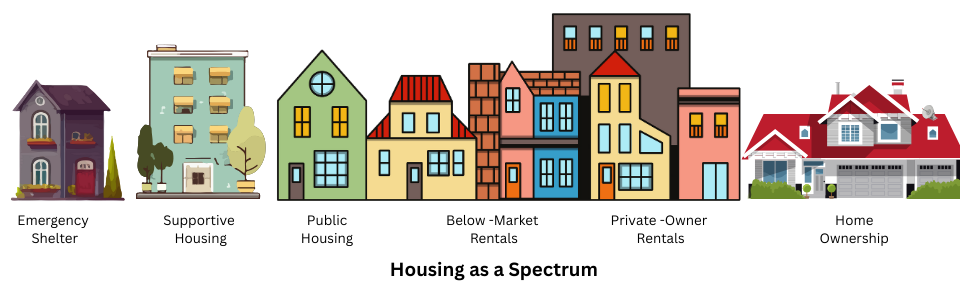
A federal rental assistance program that helps very low-income families pay for decent housing in the private market. The voucher covers part of the rent directly to landlords, while tenants pay about 30% of their income. Waiting lists are often several years long.
Public Housing
Affordable housing managed by a Public Housing Authority instead of private landlords. Funded by the federal government, these units keep rents at or below 30% of household income.
Income-Based Apartments
These are rental units where tenants pay no more than 30% of their income toward rent and utilities, regardless of their income. La Porte County has 783 income-based apartments, far too few to meet demand.
Workforce Housing
This is housing targeted to middle-income workers, teachers, police officers, and nurses who earn too much for traditional affordable housing programs but can’t afford market-rate housing in expensive areas.
Cooperative Housing
A model where residents have membership shares in the housing cooperative and participate in governance decisions. Karwick Village uses this model in La Porte County to create “forever-affordable” housing, with affordability built into the structure permanently and not dependent on ongoing subsidies.
Measuring the Need
Housing Shortage/Gap
The difference between the number of affordable housing units available and the number of households that need them. For La Porte County, studies show we need 4,000+ total housing units, including at least 240 affordable units and 660 middle-income units.
Vacancy Rate
The percentage of rental units that are currently empty and available to rent. La Porte County’s vacancy rate is 5-6%. A healthy rental market typically has a 7-8% vacancy rate, enough empty units that renters have real choices and landlords compete on price and quality. When vacancy is low, renters have fewer options and less bargaining power.
Community Development Tools
Community Development Block Grant (CDBG)
Federal grants from HUD to local governments for housing and community development activities. Projects must benefit low and moderate-income residents.
Low-Income Housing Tax Credit (LIHTC)
The primary federal program for creating affordable rental housing since 1986. Developers receive tax credits that they sell to investors, reducing their debt and allowing them to charge lower rents. Most LIHTC properties serve households at or below 60% of AMI.
Why These Terms Matter
Understanding this terminology helps you:
- Follow local housing policy discussions and planning meetings.
- Understand which affordable housing programs serve which populations.
- Evaluate whether proposed developments will actually address local needs.
- Have informed conversations with neighbors and elected officials.
- Advocate effectively for housing solutions.
When a developer proposes “affordable housing at 80% AMI,” you’ll know that might not serve the extremely low-income families most in need. When you see that the housing wage is $22/hour, but common jobs pay $18/hour, you’ll understand why so many working families struggle, even when they’re working full-time.
Even if you’re not personally struggling with housing costs, this issue affects our entire community. When nurses can’t afford to live near the hospital, when teachers commute an hour because rent is too expensive, when police officers live two towns over, everyone feels the impact.
Below you will find a few resources to begin learning about this conversation and gathering the facts needed to impact positive change in our community and beyond.
Learn More
- National Low Income Housing Coalition – Research and advocacy, including the annual Out of Reach report.
- HUD User – Data on income limits, Fair Market Rents, and housing programs
- Prosperity Indiana – Statewide housing advocacy and resources
- Health Foundation of La Porte – Local housing initiative and research
You don’t need to become an expert. Knowing these key terms helps you ask good questions and identify real solutions when they appear.