
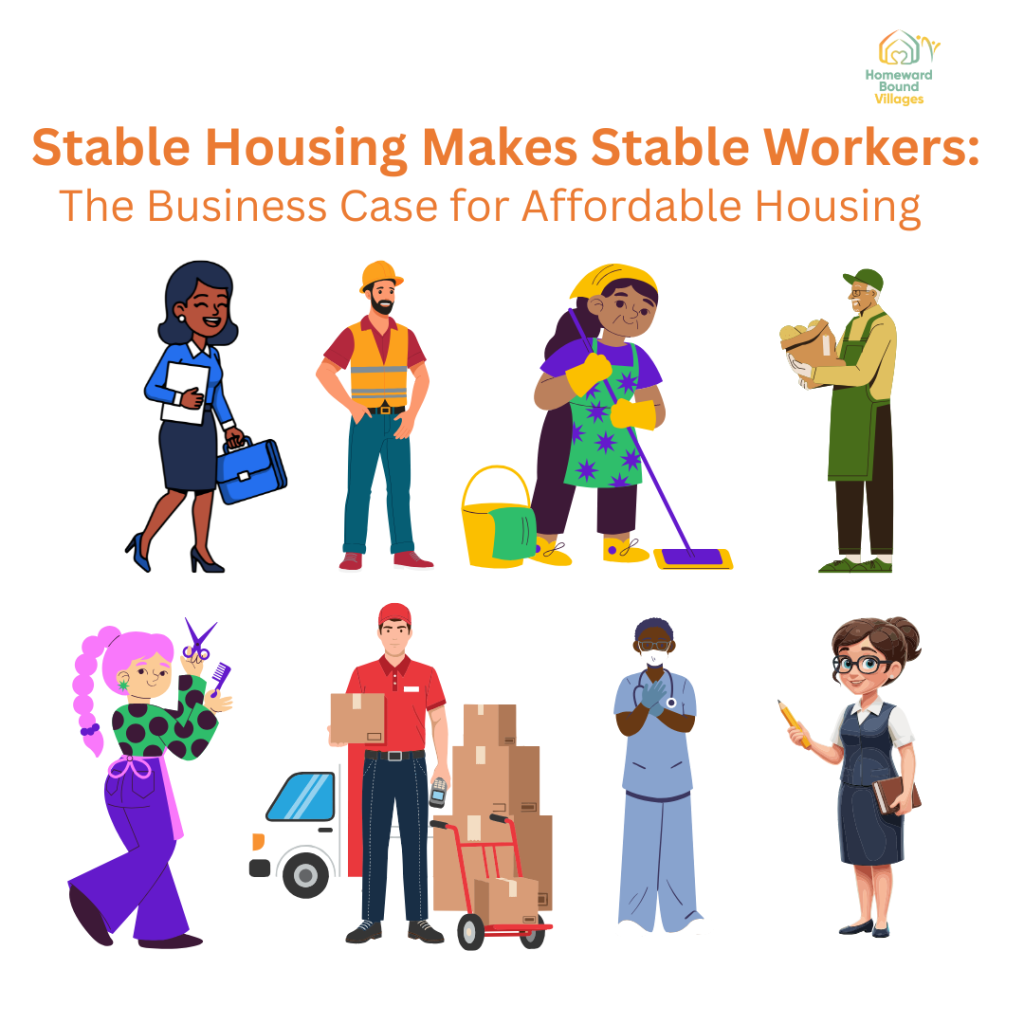
When businesses evaluate what influences workforce productivity, they often focus on training programs, competitive salaries, and workplace culture. But there’s a less obvious factor that greatly affects employee retention and performance: housing affordability. When housing is affordable, it provides stability for those working in the community, which in turn improves employee retention for employers. More simply, affordable housing helps create a stable local workforce that has a broad positive economic impact on the entire community.
Indiana’s Housing Affordability Crisis Affects Our Local Workforce
In Indiana, workers must earn $22.07 an hour to afford a modest two-bedroom apartment at fair market rent. However, the average renter in Indiana makes just $17.92 an hour; the math simply doesn’t add up.
This affordability gap has serious consequences for employers. Only six of Indiana’s 20 most common jobs pay enough to afford housing at the fair market rent. This means that 843,720 Hoosiers, more than a fifth of the state’s workforce, are working in roles that pay less than what is needed for basic housing.
Consider a home health professional earning Indiana’s median wage of $14.79 per hour. Even working full-time, this essential healthcare worker is nearly $8 short of the hourly wage needed to afford housing. These are the workers who care for our aging population, staff our hospitals, teach in our schools, serve in our restaurants, work in our grocery stores, and are critical for a healthy local economy.
The Hidden Costs of Housing Instability for Employers
When employees struggle to afford housing, businesses pay the price through:
High Turnover Costs. Research shows it costs businesses about 20% of an employee’s yearly salary to replace the worker. For a worker earning $35,000 a year, that’s more than $7,000 in recruitment, training, and lost productivity costs each time someone leaves.
Hiring Barrier: Many employers cite housing as a barrier to hiring. While Indiana has experienced a significant decline in affordability, dropping from 43rd to 34th in national rankings between 2021 and 2024. While affordability may have risen compared to other states, wages in Indiana have not.
Lost Opportunities: A national survey found that 42% of employees said high housing costs have prevented them from taking better jobs elsewhere. This means your business could be missing out on talented candidates who can’t afford to move to a certain area, or businesses may lose a current employee to opportunities in more affordable regions.
A Growing Problem in Indiana
The situation in Indiana is getting worse, not better. According to the IU Kelley School of Business, between 2020 and 2024, home values in Indiana increased by 48% while wages increased by only 23%. For renters, the gap between earnings and housing costs continues to widen, with the average renter’s wage increasing by only six cents in the past year.
The number of occupations paying enough to afford housing dropped from 10 to just 6 between 2023 and 2024, according to the Indiana Capitol Chronicle. The jobs include, but are not limited to, health aides, childcare workers, and food service jobs. This means that even in traditionally stable, middle-income occupations, workers are increasingly cost-burdened by housing expenses. This is alarming for all Hoosiers because housing is the backbone of the community and the most basic human need.
What Employers Can Do
Progressive employers understand that affordable housing is more than just a social concern; it’s a vital business necessity. Although no single employer can fix the housing crisis alone, there are significant steps businesses can take:
Support Local Housing Initiatives. Advocate for and invest in affordable housing development within the community. This can include supporting nonprofit housing developers, participating in public-private partnerships, or joining employer coalitions focused on affordable housing.
Offer Housing-Related Benefits. Consider providing housing assistance, rental subsidies, or relocation support as part of employee benefits.
Engage in Policy Advocacy. Work with local chambers of commerce and economic development organizations to advocate for policies that increase the supply of affordable housing and protect working families from displacement.
Stable Housing Creates A Stable Workforce
When employees can afford to live close to their jobs, companies see lower turnover, less absenteeism, easier hiring, and increased productivity.
With over 843,000 Indiana workers unable to afford basic housing on their current wages, the housing crisis is already affecting our community’s workforce. Supporting affordable housing isn’t just good for the community; it’s good for business.