
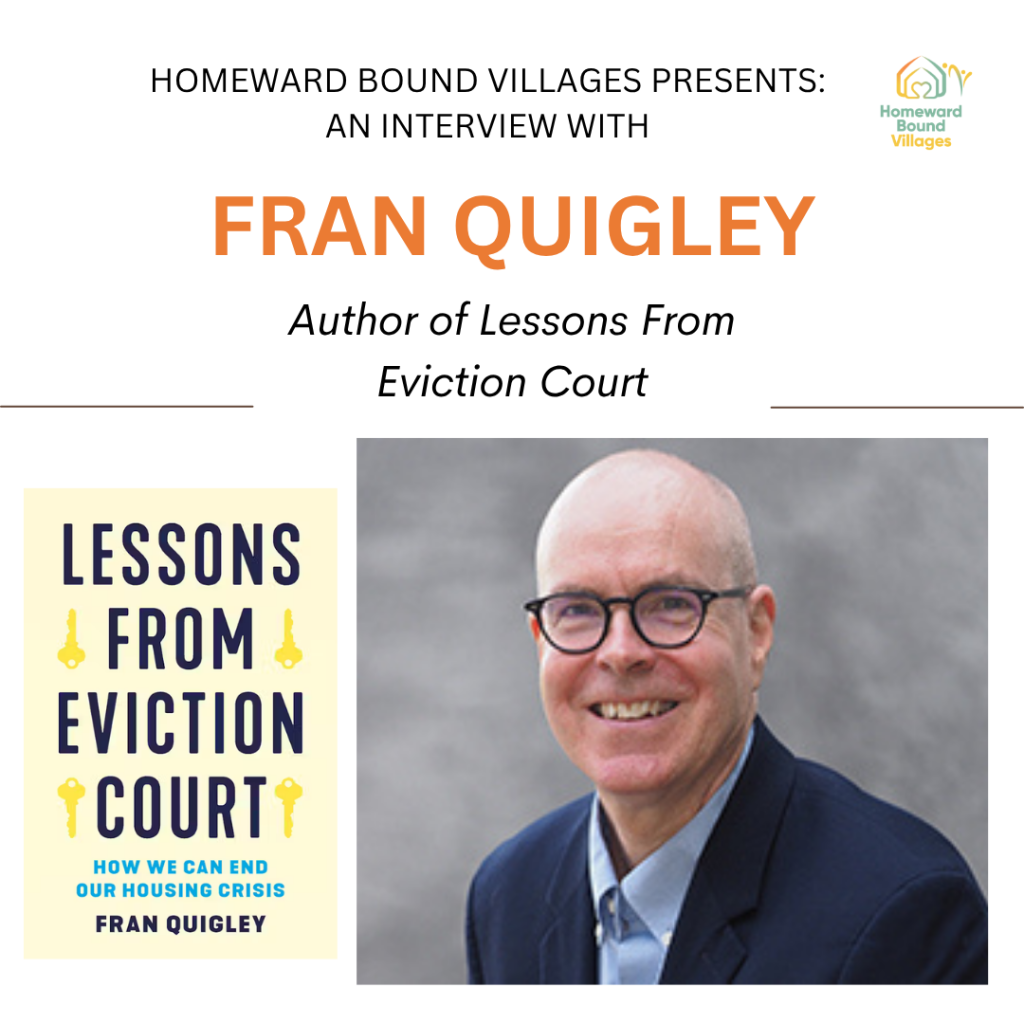
In September, we explored the powerful insights from the book “Lessons from Eviction Court,” written by Indiana eviction attorney and college professor Fran Quigley. Through our blog series, we broke down the complex realities of housing insecurity in Indiana. This past week, we had the privilege of sitting down with the book’s author, Fran Quigley, a law professor who also runs a housing law clinic at IU McKinney Law School in Indianapolis, to delve deeper into these issues and discuss what’s happening in our communities right now.
We hope that the key takeaway from this conversation was how Mr. Quigley connected the dots between policy choices, legal systems, and the real people struggling to keep a roof over their heads. This isn’t just about statistics, it shows the impossible choices our neighbors face every day.
This month, we’ve been talking about common rental barriers for low-income Hoosiers, which felt like a natural progression from your book. One surprising thing was learning how quickly evictions can occur in the state of Indiana, and how evictions can actually be a source of income for some landlords and corporate leasing companies. Can you speak more about that?
“The book [Lessons from Eviction Court] is for a broader audience than just people in Indiana, so I don’t beat up on Indiana as much as I do when we talk within the state, but we do have a very, very difficult legal environment for tenants. What we always say is it’s really ironic and a little puzzling to see that we’ve got these incredibly high eviction rates across the state when housing is relatively cheap compared to a coastal city or big metro area. And I do think that the variable that explains that is what happens with our court system—we make evictions really fast, really cheap, and really easy.
Compared to other cases we’re involved in as lawyers and law students, we recently filed an action about housing conditions and got a jury trial date of 18 months after we filed the case. That’s very common in any kind of civil case across Indiana; it’s going to take more than a year usually before you’re going to get a trial. But not evictions. If a landlord files for eviction, the case is set within days, and tenants are expected at that date to either resolve the issue or present an effective defense.
When they do so, they don’t have attorneys on their side, almost ever. In Marion County, we’ve got a program that our clinic supports where folks can get brief assistance, but across the state, almost never does a tenant walk in with a lawyer. Because they can’t afford their rent, they certainly can’t afford a lawyer.
The average length of time for an eviction hearing is five minutes. The court system is designed so thoroughly to put people out of their homes as quickly and easily as possible that we just don’t give folks a chance. And as you know from your work, that extra time means everything. If folks have two, three, maybe four weeks, they can catch up on their rent, or find a new place, or that grandma can take them in, or find a place to store their belongings. If you throw them out within days, like we do on the regular, then we’re causing homelessness.
Indiana has had a positive development in the past few years with a sealing law that’s better than it was, though it’s not ideal. Our argument—and we’ve proposed this—is that evictions should be sealed upon filing, because that’s when people are looking for another place and that eviction on the court record is very tangibly harming people. But the sealing law is a step in the right direction.
Our clinic, along with Judy Fox from Notre Dame Law School, Indiana Legal Services, and Indiana Justice Project, just issued a new report called “Too Fast, Too Easy,” saying that our courts are moving too fast and making these cases too easy. We’re calling for cases to be sealed upon filing, to have preliminary hearings, mediation—things to slow things down and try to get a resolution that isn’t a family having their belongings put on the curb.”
Let’s discuss the rental landscape in Indiana for medium- to low-income renters. Could you speak about the current rental atmosphere for low and moderate-income renters?
“We talk about it as the world’s cruelest game of musical chairs. Of the people who are eligible for subsidized housing, only one out of every four households gets it. And those three “losers” of the game? That’s who we see in eviction court.
There are people who, for whatever reason at that stage of their lives, and maybe it’s not permanent, can’t afford market-rate housing. They can’t afford what in Marion County is going to be $1,000 a month or more for one or two bedrooms. It’s folks who have kids and young kids, and they have childcare challenges, they don’t get paid much money, somebody gets sick, and they fall behind. It’s people living with disabilities. It’s persons on a fixed income. They just can’t afford the for-profit market rent, and we don’t have that option for them.
It seems so crazy when you think about it. Despite what’s happening politically, food stamps are an entitlement; if you’re eligible for food stamps, you receive food stamps. Medicaid’s an entitlement; if you’re eligible for it, you receive it. It doesn’t matter what the supply is. But with housing, if you’re eligible for it, get in line. And get in line and wait for likely years. And in the meantime, you end up homeless in a shelter, living in really dangerous conditions.
To my mind, it’s all about this dearth of subsidized housing, that we’ve just decided that three out of every four households eligible for it just aren’t going to get it. And that’s not even the most controversial political position. Presidential candidates have run on it. There’s been congressional legislation to just make housing an entitlement program like we do food and medical care. It’s not going to fix everything, but it’s going to fix a lot.”
We know that one can wait years to get a voucher, finally receive it, and then, in Indiana, it’s legal for landlords to discriminate against you using the excuse of a housing voucher. The landlord might genuinely object to vouchers, but it could also be prejudice, based on income, sex, race, or they can basically hide behind “well, I don’t take vouchers.” Can you explain that and also talk about where subsidized housing is effective?
“I think in terms of where it is working, I talked about places like Vienna and Singapore, where public housing is sought after. It’s safe, it’s clean, and it’s in attractive locations. People stay there for generations and pass it on to their kids. We have such a hard time understanding that because our public housing is so poorly maintained because it’s been starved of funding.
But the United States didn’t used to be this kind of place. Before the 1980s, we really didn’t have almost any homeless shelters. Before the 1980s, the eviction courts weren’t overflowing. Before the 1980s, you didn’t have the encampments on the street, because we did invest in subsidized housing. We had a much higher rate of investment. And then in the 1980s, it was the Reagan presidency, but it was also some Democrats in Congress—it was a bipartisan abandonment of affordable housing, which unfortunately we’ve never recovered from.
So, it’s not only other examples across the world, but also in our own history and relatively recent history. It doesn’t have to be this way.
But as you say, if we do expand the housing choice voucher program, which would be at least a big part of the short-term answer, we don’t have source of income discrimination laws in Indiana like many cities and states around the country do. Private landlords are going to have to be engaged in the program and accept vouchers. And I think something like 40% of the people who get vouchers have to turn them back in because they can’t find somebody to take them.”
That statistic is alarmingly high. And what really complicates it for truly low-income individuals is that a lot of places will have an application fee. So even before you know if you’re approved, you’ve paid a $100 non-refundable application fee. The deck is stacked against people.
“And that’s not accidental or occasional, right? This is the way it is. This structure happens when we take something that most of us think is a human right, housing, and we say the only way you can get housing is if somebody else can make money off of it. Entities make money off of application fees. They make money off of saying no to people who are poor. They make money off of filing evictions and getting extra fees out of that.
I think long-term, the answer is really clearly that we need to have a very, very robust public option. People can pay for market-rate rent, and that’s fine, but we need to have something that’s accountable to the people and not profit-motivated. We do that with public safety, schools, and all kinds of things. We say, okay, this is so important that we’re not going to just leave it to somebody making money off of it. And that’s where it works in other communities and worked in the United States in the past—we just had a whole lot more community-supported housing options that we don’t have for people today.”
One thing we talked about this past month is rental escrow. If an individual is living in substandard or actually unsafe living conditions, they still have to pay their rent in the state of Indiana or face eviction. The choice that so many Hoosiers have to make—do I keep paying rent in this substandard and dangerous living condition, or do I become homeless? I was absolutely shocked reading about this. Can you talk about it?
“When you say it’s true across the country, poor housing conditions are true across the country, but Indiana is unfortunately nearly unique in how difficult we make the burden on tenants. It’s really common in eviction court. We see somebody come in, and they’re behind on their rent. Why are you behind on the rent? Because the ceiling caved in, the landlord wouldn’t fix it, because there was mold… There are roaches. The landlord is not holding up their end of the bargain, so it makes perfect sense for them to say, “Well, why am I going to pay rent when you’re not doing what we contracted to do?”
Indiana law really explicitly doesn’t permit them to do it. We’ve been arguing that it should, but there’s no statute on the books. The legislature has given no rights for people to put money into escrow. What’s really common in a lot of places is if the tenant thinks the conditions are bad and they don’t want to pay their rent to the landlord, they can put it into an escrow account. It’s held there, and then the landlord can make a claim saying, “No, I should get it.”
Indiana is one of maybe five or six states in the Union that do not have some kind of right for tenants to withhold rent in the face of bad conditions. And what we see is that just means people live in squalor. Like you say, you make a choice—you’re going to live in squalor or you’re going to be homeless. It’s amazing how often people are forced to make that choice.
That’s the kind of thing that can be done on an individual state level. We could do better on that in Indiana. The Hoosier Housing Needs Coalition advocates for that every year at the General Assembly and struggles to get it to move. I think it has not yet had a hearing, even. But hope springs eternal, and the effort keeps going. I really appreciate people who do that. I don’t do a lot of the lobbying, and I appreciate people who do, because that’s a really uphill battle to lobby for tenants in a state where the apartment association is known to be the most powerful lobbyist in the state.”
How did you get started in this area of practice? What led you here?
“I’d always practiced what some people call public interest law or poverty law. I was a public defender right out of law school. Doing poverty law, whether as a civil rights worker or public defender, you eventually circle back to what the most essential needs of life are. Maslow’s hierarchy of needs, right? A roof over your head is really a core essential need.
We used to in our clinic do a lot of different types of cases. During the pandemic, we really switched to housing, because that was the crisis at hand. Also, some of the things in terms of access to healthcare and food, although they are a crisis now and getting worse, during the pandemic, we made some decisions at the federal and state level that we weren’t going to kick people off Medicaid, and we were going to give people maximum food stamps. So the kind of things we fought about that weren’t housing faded away. Of course, housing continued.
I had to learn myself that earlier in my career, I didn’t think representing someone being evicted from a private landlord was a high priority because if they’re behind on the rent, which is usually the case, and they can’t catch up, which is usually the case when they’re in eviction court, then what can we do? There’s no magic legal bullet to fix that.
But what we realized, what I had to learn, is that if we can get people some extra time, if we can maybe procedurally get this case dismissed so a new one has to be filed, or we just get an extension of the amount of time they’re there, then that can mean the difference. That’s why it’s so important that these cases should slow down—because those extra few weeks, if we can do that on an individual case for a client, we can make a big difference.
And also, just like your work at Homeward Bound, there’s a privilege to seeing the challenge up close. There’s a lot of people who care about it in our communities, but they don’t see the struggle. I do think this gives us the opportunity to share about what’s really going on out there and hopefully spur some support for change.”
Is there anything we haven’t touched on that you would like the readers of the Homeward Bound blog to know?
“I’ll circle back to this: homelessness and people dealing with evictions, these are political choices. The choices have been made in terms of funding, in terms of legal process, and in terms of program availability. And that means they’re fixable.
It has been fixed in other nations around the world, and we’ve fixed it in the United States before; we can do it again. So, I think it’s tempting for folks to see despair and shake their heads and say, “This is just too bad, this is the way life is.” Well, it isn’t the way life is in other nations with much less wealth than we have. We give government subsidies for landlords and homeowners. If we can just make those equally available to low-income people, we can empty out the shelters, we can empty out the eviction courts. We can absolutely solve this problem the day we decide we want to.”
We want to thank Mr. Fran Quigley for his time to sit with Homeward Bound Villages for this interview. To learn more about “Lessons from Eviction Court” and the housing challenges facing Hoosiers, visit your local bookstore. For more information about affordable housing advocacy in Indiana, check out the Hoosier Housing Needs Coalition.
About the Law Clinic
The author teaches at IU McKinney Law School in Indianapolis, where the clinic represents mostly tenants in Indianapolis and occasionally in surrounding areas. They partner closely with Indiana Legal Services, which has offices throughout the state, including in South Bend and Fort Wayne. The clinic offers law students their first opportunity to practice in court and work with clients, while also exposing them to the housing struggles in our communities—hopefully inspiring the next generation of judges, legislators, and nonprofit leaders to create meaningful change.