
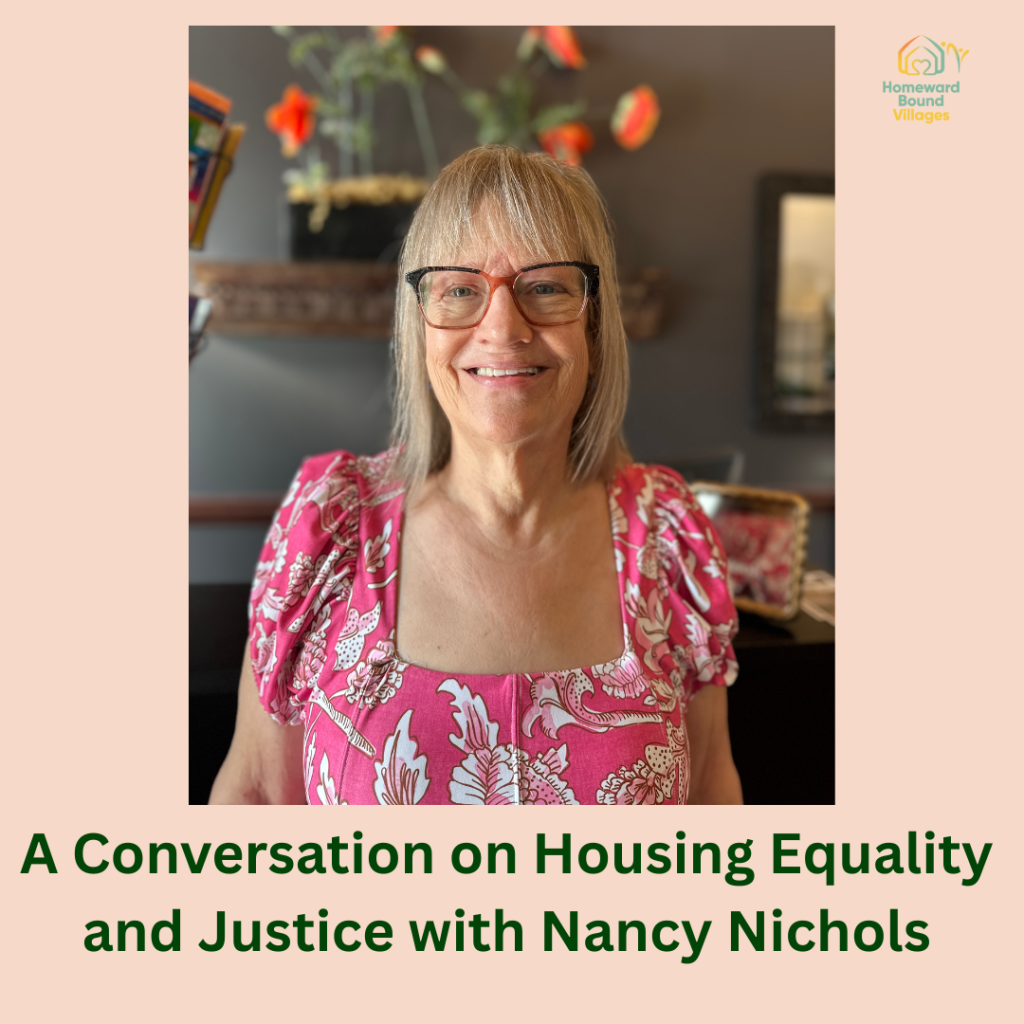
We sat down with Nancy Nichols, a longtime Homeward Bound Villages board member and Reverend of First United Methodist Church of Michigan City, to discuss her extensive experience with housing advocacy across Indiana communities. Her insights reveal the complex intersection of housing, dignity, and systemic justice. We want to thank Reverend Nichols for sharing her wealth of experience in this interview below with all of us.
Please tell us about the beginning of your journey into housing advocacy.
“I grew up in a small town and never even thought about housing being an issue, although I had friends and family who struggled with it. That changed my senior year in college when I did an urban studies program in Chicago. I had an internship working with a church in a marginalized community and with the Chicago Rehab Network, which focused on how to improve housing stock without totally gentrifying neighborhoods and displacing people who had always lived there.
I remember having a conversation with somebody on the El train, and she was talking about who used to live in that house and who used to live in this house. She didn’t know how much longer she could afford to live because her taxes had gone up so much, and just how it felt to be kicked out of her neighborhood. That started me on a broader journey of looking at how justice works when the people advocating for change live in privilege rather than those who are struggling with the reality of their neighborhoods.”
How did that experience shape your ministry and advocacy work?
“Everything came together when I went to seminary and continued working with justice issues, putting a theological perspective on it. Years later, when I was doing urban-focused ministry, I was working part-time in the church and part-time doing support work and advocacy for families at risk for child abuse. That’s when I got into some of those houses and saw how people were living—the quality of their housing and the rents they paid.
I began to recognize that because they were living in poverty, in houses with lead, in places where the floorboards were rickety, they were at risk of losing their children much more so than people who lived more affluent lives.”
What did you observe about the impossible choices people face?
“When I was appointed to a church in South Bend, I saw what happens when someone can’t afford both housing and food or medication. I worked with mothers who would say, “I can go buy a pack of cigarettes and make that last for this amount of money and not be hungry because of the cigarettes, so that my children can have my food to eat.”
We’re always so harsh on people who spend their money on smoking, which is designed to be addictive. But I had never stopped to think—that’s why she’s so skinny. It isn’t that she doesn’t want to eat. She’s choosing not to eat so that her children can have the food available to them.”
How do housing challenges intersect with other issues like food security?
“In South Bend, I worked with Unity Gardens, which now has a 13-acre location where they teach and learn from each other about gardening skills, beekeeping, canning, and food production. When I was involved, there were 72 neighborhood gardens throughout the city where you didn’t have to buy into the garden to harvest from it. If you wanted to help, you could, but if you just needed to pick a tomato for lunch, you could.
But we’d say, “Why don’t you plant a garden?” and people would respond, “Well, my landlord won’t let me,” or “The soil isn’t safe,” or “I’m so transitional—why should I plant a garden when I won’t be there to harvest it?” So, we did flowerpot gardens and all kinds of things to help address those issues.”
How did you become involved with Homeward Bound Villages?
“By maybe July 15th of my first month in Michigan City, John Vander Wagen and Leigh Coburn (Homeward Bound Villages Co-Founders) were in my office saying, “You need to read this book, and would you like to be on our board?” At that point, they were not aware of my extensive background in housing. They knew I was a pastor at the church where John was a member, and this was his passion. He could probably tell from my first couple of sermons that I’m not a status quo kind of person.
I’ve been involved with Homeward Bound since my first month in Michigan City (2018), and we broke ground before I leave in 10 days for Evansville. It’s incredible timing, such a gift.” Nancy will be leaving Michigan City this month for a new calling in Evansville, IN.
What are some misconceptions you encounter about affordable housing?
“People ask, ‘Why are you giving those lazy bums a chance?’ or say, ‘They’re just going to turn it into another problematic area.’ That’s not what we’re doing. We want people who can afford to live there to be successful in living there, to have some longevity, and to have ownership over the decisions being made about how they live. That’s the only way we can break the cycle of the housing crisis.
I can’t afford to retire here (Michigan City), and I’ve been working a full-time professional job for 41 years. So, how can we expect those who are starting out, or those who struggle with mental illness that can be controlled but can’t afford both housing and psychiatric medications?”
What’s your perspective on how we define people’s experiences?
“As long as we define what people’s experiences are from the position of privilege, we’re never going to get there. That’s what I love about Homeward Bound Villages—we’re not making the decisions for how they’re going to live.
When I look at scripture and it says how you treat that person is how you’re treating Jesus, we’ve got some learning to do. Jesus never stood in a position of privilege to tell people how they were to be. He always stood with people. For all of us to live equitably and with justice, some of us will have to give up, and others will have to step up. It’s not one or the other—it’s both, and 100% from each.”
How do you view the relationship between capitalism and housing?
The entire concept of capitalism is built on the shoulders of the poor. Those of us who do live in more privilege, and I certainly do with my education and having lived in beautiful communities, can’t forget that capitalism is built on the idea that you’re going to pull yourself up by your own bootstraps, and I don’t have to be involved because you are responsible for your boots.
About 25 years ago, I was listening to Fresh Air on NPR, and they interviewed Earl Shorris about his book “The New American Blues.” The first half drew an amazing picture of the forces that keep people stuck. He created an argument that solving issues of poverty, homelessness, and inadequate affordable housing isn’t an individual problem; it’s a social problem. His analysis was phenomenal, though I didn’t like his individual-focused solutions.”
Can you share an example of how historical policies created lasting disparities?
“My dad was a World War II veteran. My friend’s father, who lived on the banks of the Ohio River, was also a World War II veteran. My father could use the GI Bill to secure a graduate degree from an excellent university and purchase a home in an emerging community. My friend’s father, who put his life on the line just like my dad did, was not able to broker the GI Bill in the same way because he was African American.
The housing he could purchase was redlined. The education he could get may or may not have been of equal value. So, starting 80 years ago, the imbalance began long before World War II, but the way people have been able to overcome the GI Bill’s challenges shows how systemic barriers can compound over generations.”
What would you want people to take away from this conversation?
“Don’t make assumptions that you know what other people are going through. Don’t make assumptions that people can’t afford housing because of some lack of moral strength on their part.
Solving housing is as complex as individuals are, and no two of us are exactly the same. There’s no one answer. It’s a complex issue, and anytime you have people at the heart of an issue, it’s going to be very complex.”
How do you define wealth and choice in this context?
“Wealth is not necessarily financial; it’s choice. When you have choices and you can make decisions in your life, sometimes wealth buys that, sometimes cooperation buys that. But it’s about choice.
What I see Homeward Bound Villages doing is opening doors and windows, but the individuals we are serving are the ones who must and who will walk through those doors and open those windows. I don’t do it for people, but I will help open the door and hold it for them as they make whatever choice it is. If they choose to walk through the door, then the house is bigger than the door. If they choose not to, that’s their choice.”
Any final thoughts on housing justice?
“In the Hebrew scriptures, there was the concept of the Jubilee year to rebalance everything so you wouldn’t have great disparity of wealth. I don’t know that it ever worked, but what would happen if, on a regular basis, people’s debt were forgiven and things could be rebalanced and equalized—not to disparage those who have worked hard, but to balance out some of the systemic issues?
We believe that the way to wealth and stability is homeownership and education, but not everyone has had equal access to those paths. That’s why we need to think systematically about justice, not just individual charity.”
Thank you again to Reverend Nichols for sharing her experience with housing equality and justice with us.