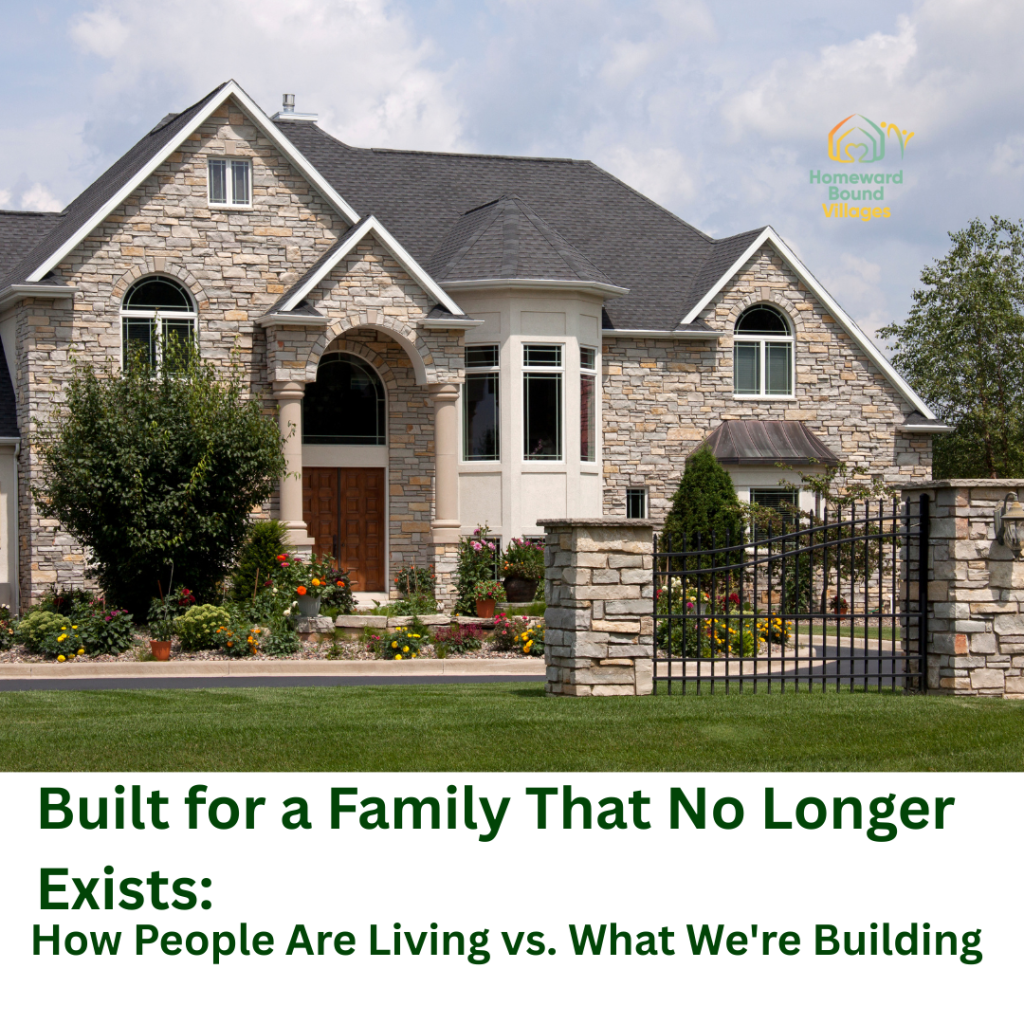
The American dream is a cute three-bedroom house with a white picket fence outside, a formal dining room and living room, a yard, and possibly a garage. This image was cultivated and realized in the housing boom after World War II, when millions of Americans bought homes for growing families. Yet over the years, as families shrank, homes grew larger and were designed for a lifestyle that is becoming rarer.
In 1960, the average household had 3.33 people. By 2020, that number had fallen to 2.55, according to U.S. Census data. Today, more than 27% of occupied homes in America house exactly one person, and over 60% have just one or two occupants. Meanwhile, families are shrinking, yet homes continue to be built larger.
Housing Data Points:
- Forty-eight percent of new single-family homes built in 2022 had four or more bedrooms, compared to only 20% in 1980.
- Sixty-four percent of new homes had at least three bathrooms — an increase from 24% in 1980.
- The Average new home size in 2026: 2,300 square feet. Average new home size in 1950: 983 square feet.
- We are building homes 2.5 times larger for families that are 1.5 times smaller. The math doesn’t add up, and neither does the affordability. Put simply, we are building homes in mass for a lifestyle that no longer exists.
Who Is Actually Living in America Right Now
The traditional nuclear family still exists, but it now shares the scene with a much more diverse range of households, and housing isn’t keeping up.
Older Americans: Adults over 65 now make up more than 16% of the population, and households led by someone over 65 will account for 34% of all households by 2038. More than three in four Americans over 50 want to age in place. They don’t need more bedrooms; they need accessible, manageable spaces.
Millennials: Nearly 52 million Americans are in their 30s. Student debt, delayed marriage, and soaring housing costs have changed how this generation forms households. From 2000 to 2017, the percentage of young adults living with their parents almost doubled. Young adults living with roommates or extended family increased from 5% to 21% of all households. They’re adapting, but the housing stock isn’t built for how they actually live.
Solo households: In 1960, only 5% of Americans lived alone. Today, nearly 1 in 3 does. Solo households don’t require four bedrooms or a formal dining room; they need efficient, affordable spaces in walkable neighborhoods. This type of housing is consistently underprovided.
The result is a fundamental mismatch between inventory and need.
Rooms Nobody Uses
Ask any real estate agent what rooms buyers say they never use: formal living rooms, formal dining rooms, bonus rooms, and that third or fourth bedroom that becomes a storage space.
These are the rooms that drive up construction costs and home prices in terms of square footage, property taxes, utilities, and furniture. For most buyers today, these extra rooms aren’t meeting a need people actually have.
According to an article from the Brookings Institution, in the country’s 15 largest metro areas, homes with four or more bedrooms are at just 55% capacity on average. Meanwhile, one-bedroom units are near or over capacity in New York, San Francisco, Los Angeles, and Riverside.
Bedrooms are sitting empty in big houses while people stack into the smaller units they can find and afford.
We face a nationwide housing crisis. Nearly 4 million homes are needed, yet we continue to build the most expensive types of housing. In 2024, the average new home price exceeded $498,000. Home prices roughly doubled over the last decade. Meanwhile, median household income has barely changed.
Why Are We Still Building This Way?
The system has a long memory and a slow metabolism.
Zoning codes: Much of America’s land use still follows regulations from the 1950s and 60s which were created to protect single-family suburban neighborhoods. These codes make it either illegal or financially impractical to build the smaller, denser housing that today’s households actually need.
Builder economics: Larger, more costly homes yield better margins. As rising land, labor, and material costs squeezed profits on smaller starter homes, builders stopped building them.
A coming generational shift: As baby boomers move out of homeownership, millions of large suburban homes will hit the market, and there may not be enough buyers interested at the prices these homes will command. In simple terms, they’re too expensive.
According to the website Realtor.com, the Midwest is especially exposed. At current construction rates, some analysts project it could take four decades to close its housing supply gap, and it’s building precisely the kind of housing that younger households are least able to afford.
What Housing Could Look Like Instead
Awareness is growing, and some builders are beginning to respond.
New home designs increasingly emphasize function over square footage, open floor plans, dual-purpose rooms, and flexible layouts that accommodate a home office, an aging parent, or a multigenerational living arrangement without requiring a formal wing.
ADUs (accessory dwelling units) have surged where they’ve been permitted, allowing existing properties to serve multiple households without new land development.
Manufactured housing has emerged as one of the few truly affordable ownership-track options precisely because it sidesteps the land and labor costs of site-built construction.
Townhomes and small-lot single-family homes in walkable neighborhoods are being bought almost as quickly as they are built, indicating where demand truly exists.
On the policy side, over a dozen states have passed or are considering zoning reform laws that would permit duplexes, triplexes, and small apartment buildings in neighborhoods previously limited to single-family homes.
Recognizing The Issue is the First Step in Impactful Change
America’s housing crisis is often seen as a shortage issue. And it is, we lack enough homes. But it’s also a mismatch issue. We have too many of the wrong homes in the wrong locations at prices that don’t match the incomes or lifestyles of those who need housing the most.
The traditional nuclear family for which America’s housing stock was built still exists. However, it now coexists with 33 million single-person households, multigenerational families under one roof, aging generations who prioritize a zero-step entry over a fifth bedroom, and young professionals who prefer 900 square feet near good transit rather than 2,400 square feet and a two-hour commute.
Until the housing industry and the zoning laws that govern it catch up to who Americans actually are, we’ll keep building the same house for the same family that fewer and fewer of us want to be.
Sources:
U.S. Census Bureau — New Residential Sales Data
CBRE Investment Management — “Digging Out of the U.S. Housing Affordability Crisis”
Realtor.com Housing Supply Gap Report (via HousingWire)
First American Financial — “3 Forces Shaping the Housing Market in 2026”
HUD & U.S. Census Bureau — Monthly New Residential Sales, October 2025